BLOGS
Electric Scooter Spare Parts Inventory: Compatibility, SKU Taxonomy, and Stocking Framework for Overseas Dealers
2026-09-20
Electric Scooter Spare Parts Inventory: Compatibility, SKU Taxonomy, and Stocking Framework for Overseas Dealers
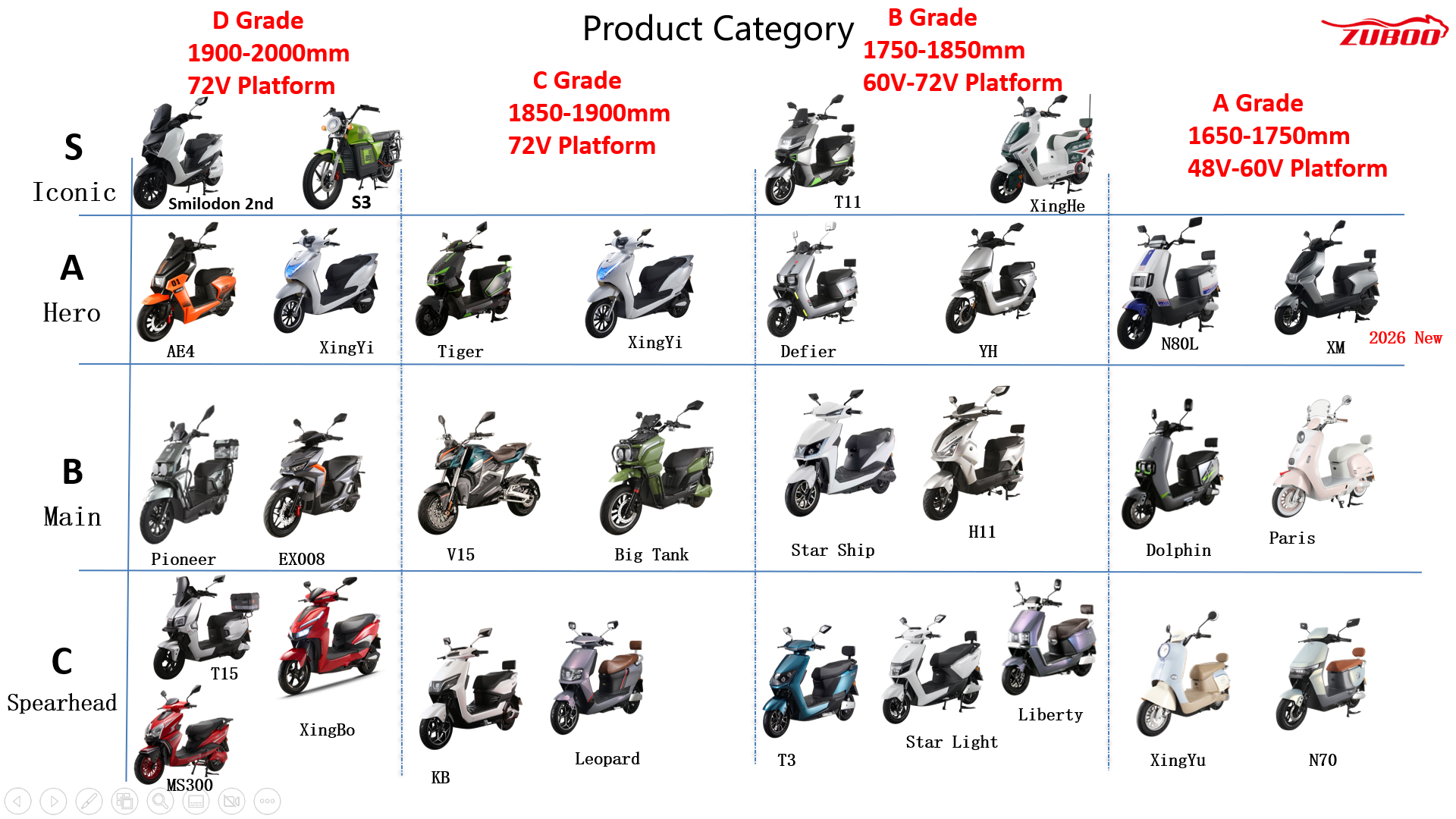
Published: 2026-09-17 Last updated: 2026-09-17 Technical Information Verified: 2026-09-17 — when the underlying specifications, regional market data, and after-sales workflow were last checked Last Verification Method: Zuboo first-party cross-check (current production SKUs, RMA procedure, regional BR / PK / TZ stocking annex) and Tier 3 engineering reference (battery chemistry table, IP-rating table, three motor-controller configurations, Hall-sensor pinout variability, decision flowchart, 90-day consumption template). IEC 61851-1 referenced only within its defined AC-charging scope. Data Sources Checked: Zuboo first-party operational knowledge of 48V / 60V / 72V platforms (BLDC motor specifications, product range, after-sales service & RMA procedure, regional spare-parts annex BR / PK / TZ, 90-day consumption analysis template, Tier 3 engineering reference v1.0); IEC 61851-1:2017 (in-scope only); Wikipedia, “Brushless DC electric motor” (engineering reference). Applicable Product Version: Zuboo current-production 48V / 60V / 72V e-scooter, e-moped, and e-motorcycle platforms (Hero, N70, XingYi, XingRen, Tiger, Defender, MS300, T3, T11, S3, Smilodon 2nd, and the broader S / A / B / C grade matrix across Iconic / Hero / Main / Spearhead size categories). Spec Version: v1.4 — rated-motor-power terminology unified, regional-data methodology explained, Entity Summary replaced by natural introduction, IEC 61851-1 references compressed, FAQ Q1 corrected on battery stocking. Next Review Due: 2027-03-17 Author: Zuboo Technical Team Publisher: Zuboo Technology
TL;DR
- For overseas electric-scooter dealers, an Electric Scooter Spare Parts Inventory is best organised around a system-level SKU taxonomy — not a flat list of components.
- The fastest-movers are brake components, controls (throttle, display), and electrical assemblies; these scale up sharply outside the Sri Lanka baseline in every regional case study.
- Compatibility requires four checks: voltage platform, current or power rating, connector or pinout family, and firmware or protocol version (where applicable). Match by pin number, not by wire colour, for Hall-sensor connections.
- Rated Motor Power is the only power figure used in this article; nominal, continuous, and peak wattage are explicitly distinguished where technically necessary.
- IP rating describes ingress protection under defined test conditions — it is one part of environmental suitability, not a complete guarantee of climate readiness.
- ABC/XYZ and Re-Order Point (ROP) are the recommended inventory-planning frameworks, with the 90-Day Consumption Analysis Template as the practical implementation tool.
- The Zuboo Regional Annex BR / PK / TZ provides market-specific starting recommendations; treat them as planning references, not as universal industry failure rates, and re-validate against your own 90-day consumption.
- For dealers with their own after-sales capability, a spare-parts allocation of approximately 1% of the order quantity is offered as a customer-managed option, with regional multipliers (Brazil ≈ 1.3%, Pakistan ≈ 1.5%, Tanzania ≈ 1.8%); the standard one-year warranty and the customer-managed spare-parts allocation are two separate commercial arrangements.
Introduction
Spare-parts inventory is one of the most overlooked factors in overseas electric scooter distribution. A dealer may have sufficient vehicle stock but still face customer complaints, long repair times, or unnecessary working capital if critical replacement parts are unavailable. The challenge is not simply deciding how many parts to keep. Dealers must also understand vehicle compatibility, voltage and connector differences, environmental exposure, usage intensity, and replenishment lead times. This guide explains how to organize electric scooter spare parts by SKU, evaluate compatibility, estimate regional stocking needs, and build a practical inventory framework for overseas after-sales support.
Core Definitions
Definition: SKU A Stock-Keeping Unit (SKU) is a unique identifier for a specific part variant — typically combining the OEM part number, voltage platform, connector family, and revision. In this article, a SKU is treated as platform-specific, not as a generic nominal-voltage equivalent.
Definition: Compatibility Compatibility means that a replacement part satisfies four checks simultaneously: voltage platform, current or power rating, connector or pinout family, and firmware or protocol version (where applicable). A controller and motor that share nominal voltage are not automatically compatible.
Definition: Rated Motor Power Rated Motor Power is the manufacturer’s published continuous-output power rating for a motor under standard operating conditions. Throughout this article, “Rated Motor Power” is used in preference to nominal, continuous, or peak wattage wording, except where a specific distinction (for example, peak vs. continuous) is technically necessary.
Definition: IP Rating An IP (Ingress Protection) rating, per IEC 60529, describes an enclosure’s resistance to dust and water ingress under defined test conditions. IP rating is one part of environmental suitability, not a complete guarantee of climate readiness.
Definition: ABC/XYZ Classification ABC/XYZ is an inventory-planning framework that groups SKUs by annual consumption value (A = highest consumption value, B = medium, C = lowest. In many inventory systems, A items account for a disproportionate share of total consumption value, although the exact distribution depends on the product range and classification thresholds.). The thresholds below are the fixed default thresholds used in the accompanying inventory-planning template; they provide a consistent starting point for dealer analysis and can be adjusted when a different service strategy or inventory policy is required.
Definition: Low-Consumption but Critical Components Low-Consumption but Critical Components are parts with low annual consumption but high operational importance — for example, structural brackets, specific mounting hardware, uncommon but vehicle-critical electrical assemblies, or specialised connectors. These are not ordinary low-priority C items; failure can immobilise a vehicle or significantly affect safety and service continuity.
Core Spare-Part Categories and SKU Taxonomy
A well-organized Electric Scooter Spare Parts Inventory rests on a system-level view of the vehicle rather than on isolated component categories. Before stocking any single SKU, dealers need a shared taxonomy that maps every spare part to the vehicle platform it actually fits.
Three Motor-Controller Configurations
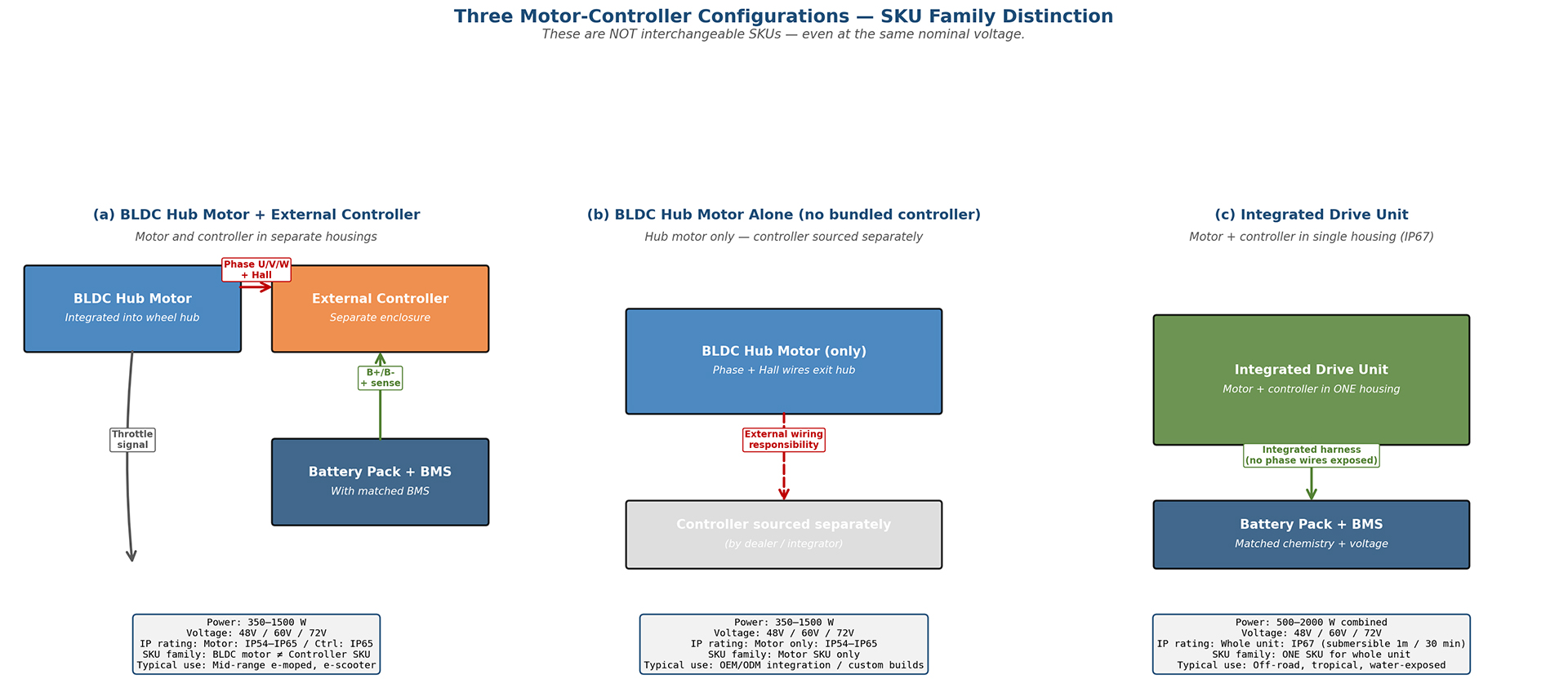
A practical SKU taxonomy distinguishes three motor-controller configurations. They are not interchangeable SKUs, even at the same nominal voltage.
| Configuration | SKU family | Field-replaceable as | Typical use |
|---|---|---|---|
| (a) BLDC Hub Motor + External Controller | Motor SKU ≠ Controller SKU | Motor and controller replaced individually | Most e-scooters, e-mopeds |
| (b) BLDC Hub Motor Alone | Motor SKU only; controller is integrator’s choice | Motor only | OEM/ODM integration projects |
| (c) Integrated Drive Unit | ONE SKU for the whole unit | Whole unit (not field-serviceable internally) | Off-road, tropical, water-exposed platforms |
A controller calibrated for one pairing may not safely drive another, even at the same nominal voltage.
Vehicle Voltage Platforms vs. Motor Voltage Ratings
Vehicle voltage platforms and motor voltage ratings should not always be treated as identical specifications. On some Zuboo product platforms, different motor configurations are used to match terrain, load requirements, speed targets, and controller settings. Motor selection depends on controller compatibility, winding design, operating conditions, load, terrain, and target performance. Dealers should not select replacement motors based solely on nominal battery voltage; compatibility should be confirmed through the complete vehicle configuration.
Zuboo BLDC Hub Motor Specifications
Zuboo currently produces seven BLDC hub motor SKUs across the 48V / 60V / 72V range. Cross-check the controller’s phase-current limit against the motor’s rated power before pairing.
| Zuboo motor SKU | Wheel size | Rated Motor Power | Pole pairs / slots | Speed window — 48V / 60V / 72V (km/h) | Typical pairing |
|---|---|---|---|---|---|
| 60V-215-30H-1.8-550R | 10″ | 1000 W | 26 / 48 | 30–32 / 39–41 / 44–46 | N70, Defender, mid-size urban e-scooter |
| 60V-215-30H-2.3-550R | 10″ | 1200 W | 26 / 48 | 32–34 / 41–43 / 46–48 | N70 extended, T3-series entry |
| 72V-215-35H-2.3-730R | 10″ | 1500 W | 26 / 48 | —/43–45 / 53–55 | T11, Hero mid-tier |
| 72V-215-40H-2.3-850R | 10″ | 2000 W | 25 / 45 | —/50–53 / 62–65 | T15, XingBo mid-power |
| 72V-260-30H-2.5-700R | 12″ | 2000 W | 30 / 54 | —/48–52 / 60–65 | XingRen Boda, cargo / passenger |
| 60V-260-35H-2.3-730R | 12″ | 2300 W | 28 / 63 | —/— / 55–60 | Tiger, MS300 heavy urban |
| 72V-260-35H-2.5-900R | 12″ | 2500 W | 30 / 54 | —/ —/ 70–73 | Smilodon 2nd, AE4 performance |
The speed ranges in this article are practical reference values based on typical vehicle configurations and field experience. Actual performance varies with motor and controller settings, battery condition, rider load, terrain, temperature, and local regulations. These figures should be used for preliminary parts planning rather than treated as standardised test results.
All seven SKUs use controller-side current limiting rather than a current limit defined by the motor itself. When pairing a motor and controller, dealers should check the controller’s bus-current and phase-current limits against the motor’s Rated Motor Power, voltage platform, and intended operating conditions.
Ten Spare-Part Categories — System View
| Category | Voltage platform | Typical power / current | Connector family | IP rating | Evidence tier |
|---|---|---|---|---|---|
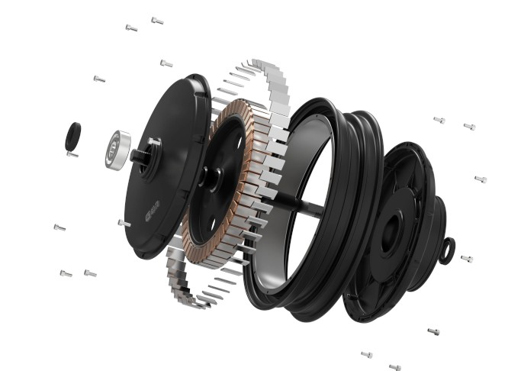
| BLDC hub motor | 48V / 60V / 72V | 1000–2500 W rated motor power | Phase U/V/W + 5- or 6-pin Hall lead | IP54–IP65 (IP67 in integrated drive unit) | Tier 4 (Zuboo) |
| External controller | 48V / 60V / 72V | Bus 32–60 A; phase 115–250 A | Phase + Hall + throttle + display | IP65 | Tier 4 (Zuboo) |
| Integrated drive unit | 48V / 60V / 72V | 500–2000 W combined | Integrated harness (not field-disassembled) | IP67 | Tier 4 (Zuboo) |
| Battery pack (Li-ion NMC) | 48V / 60V / 72V | 10–30 Ah typical | XT60 / XT90 / Anderson | IP65 | Tier 3 (chemistry table) |
| Battery pack (LiFePO4) | 48V / 60V / 72V | 15–40 Ah typical | XT90 / Anderson | IP67 | Tier 3 (chemistry table) |
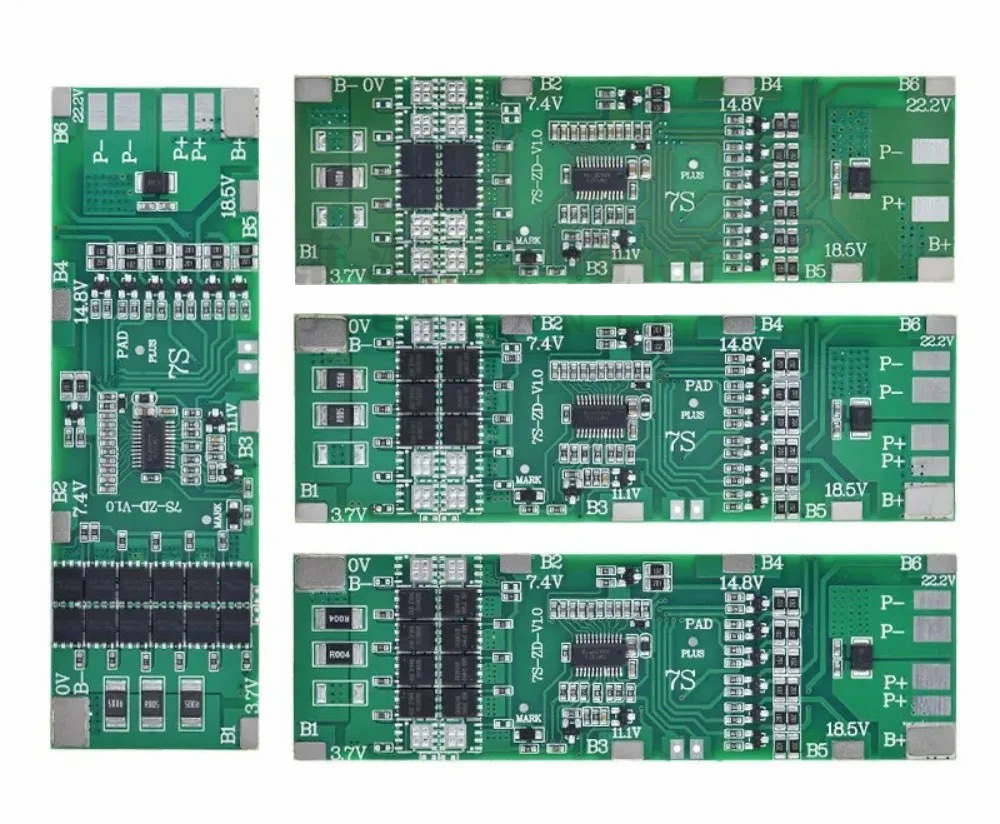
| BMS | Pack-matched | 30–60 A continuous | B+ / B- / cell-sense pads | — | Tier 3 (engineering) |
| Charger | 48V / 60V / 72V | 2–10 A output | 3-pin AC / DC barrel | IP54 | Tier 3 (engineering) |
| Display | All platforms | < 500 mA | 5- or 6-pin signal | IP65 | Tier 4 (Zuboo) |
| Throttle | All platforms | Hall-effect 0.8–4.2 V | 3-pin | IP54 | Tier 4 (Zuboo) |
| Brake components | All platforms | Mechanical or hydraulic | — | IP54 (lever) | Tier 4 (Zuboo) |
| Wiring harness | All platforms | Wire-gauge dependent | Model-specific | IP54–IP65 | Tier 4 (Zuboo) |
Compatibility and Matching
System-level matching is the single most common source of return and rework in a dealer’s service bay. Stocking the right SKUs matters less than stocking SKUs that actually fit the platform they will be installed on. Each rule below should be checked against the manufacturer datasheet before a SKU enters the active catalog.
Battery Chemistry × Voltage × Full-Charge Voltage
Cross-chemistry charging is unsafe. The table below is the standard reference for matching chargers to battery packs; verify the specific cell vendor’s datasheet before specifying a charger.
| Platform | Chemistry | Series cell count | Nominal voltage | Full-charge voltage | Per-cell maximum |
|---|---|---|---|---|---|
| 48V | Li-ion (NMC) | 13S | 46.8 V | 54.6 V | 4.2 V/cell max |
| 48V | LiFePO4 | 16S | 51.2 V | 58.4 V | 3.65 V/cell max |
| 60V | Li-ion (NMC) | 16S | 57.6 V | 67.2 V | 4.2 V/cell max |
| 60V | LiFePO4 | 20S | 64.0 V | 73.0 V | 3.65 V/cell max |
| 72V | Li-ion (NMC) | 20S | 72.0 V | 84.0 V | 4.2 V/cell max |
| 72V | LiFePO4 | 24S | 76.8 V | 87.6 V | 3.65 V/cell max |
A 48V Li-ion charger outputs 54.6 V; a 48V LiFePO4 charger outputs 58.4 V. They are not interchangeable, even though both carry the “48V” nameplate. LiFePO4 packs have a flatter discharge curve than NMC — the same SOC percentage corresponds to a narrower voltage band.
Motor ↔ Controller
Match the voltage platform, the controller’s phase-current limit, the Hall-sensor arrangement (by pin number, not wire color), and the connector family. A 32 A controller driving a 1500 W rated-motor-power hub motor is a different SKU family than a 60 A / 250 A controller driving the same motor.
Hall-Sensor Pinout Variability
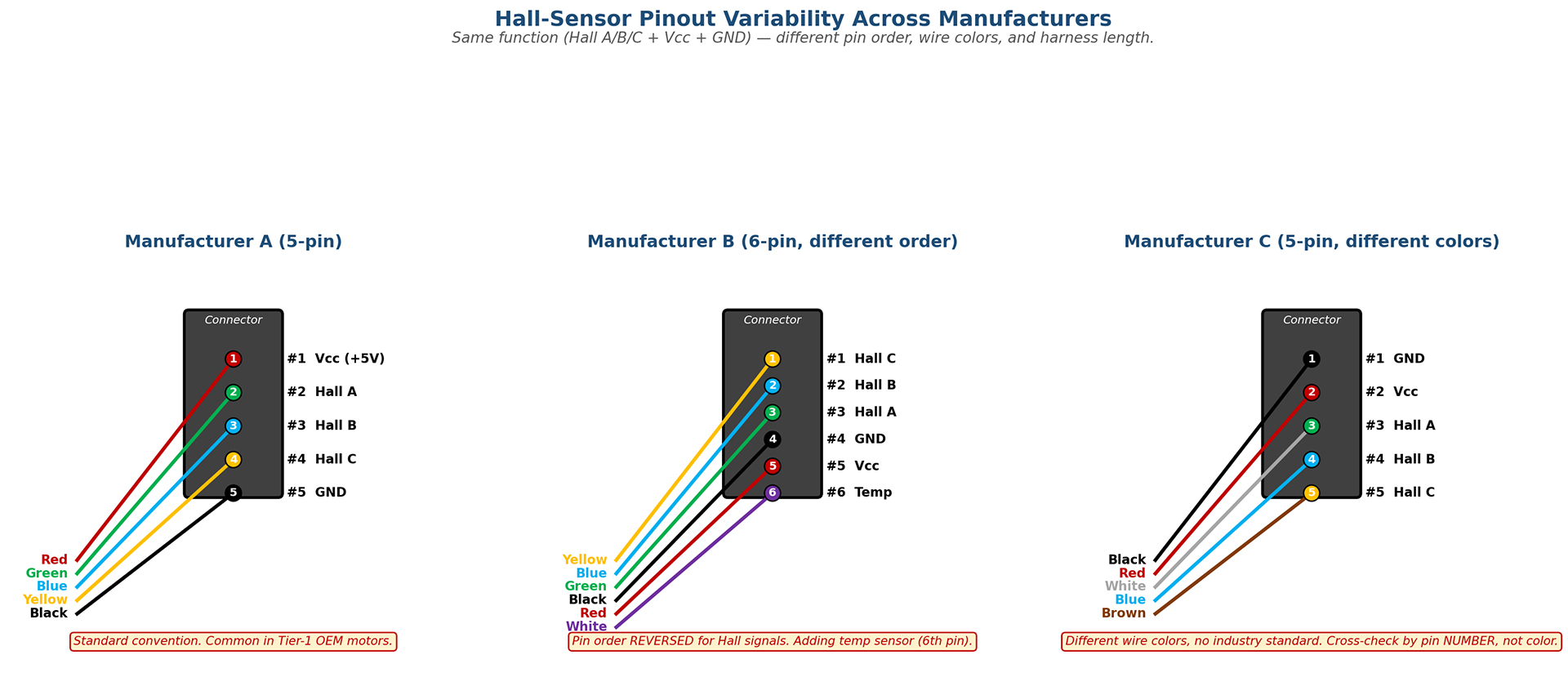
| Variant | Pins | Wire colours (motor-side lead) | Notes |
|---|---|---|---|
| Mfr A — standard 5-pin | #1 Vcc (+5V), #2 Hall A, #3 Hall B, #4 Hall C, #5 GND | Red / Green / Blue / Yellow / Black | Standard convention. Common in Tier-1 OEM motors. |
| Mfr B — 6-pin with temperature | #1 Hall C, #2 Hall B, #3 Hall A, #4 GND, #5 Vcc, #6 Temp | Yellow / Blue / Green / Black / Red / White | Pin order REVERSED for Hall signals. Adds a temperature sensor on pin 6. |
| Mfr C — 5-pin with different colours | #1 GND, #2 Vcc, #3 Hall A, #4 Hall B, #5 Hall C | Black / Red / White / Blue / Brown | Different wire colours, no industry standard. Cross-check by pin NUMBER, not colour. |
In Hall-equipped BLDC motors, the typical functional signals are Vcc, GND, Hall A, Hall B, and Hall C, with optional temperature or other sensing lines. However, pin order, wire colours, connector gender, and harness length vary between manufacturers and even between model years within the same vendor. A 5 V logic level is typical but should be verified on the SKU datasheet.
Battery Voltage ↔ SOC Shortcut
A lower-voltage charger will not fully charge a higher-voltage pack to its specified full-charge voltage. SOC depends on chemistry, load conditions, cell drift, and temperature. Pack voltage is one input to SOC estimation, not a substitute for a calibrated BMS-based reading.
Connector and Harness
Many warranty returns trace back to a connector pinout mismatch or a missing sense wire. Stocking model-specific harnesses reduces this failure mode considerably.
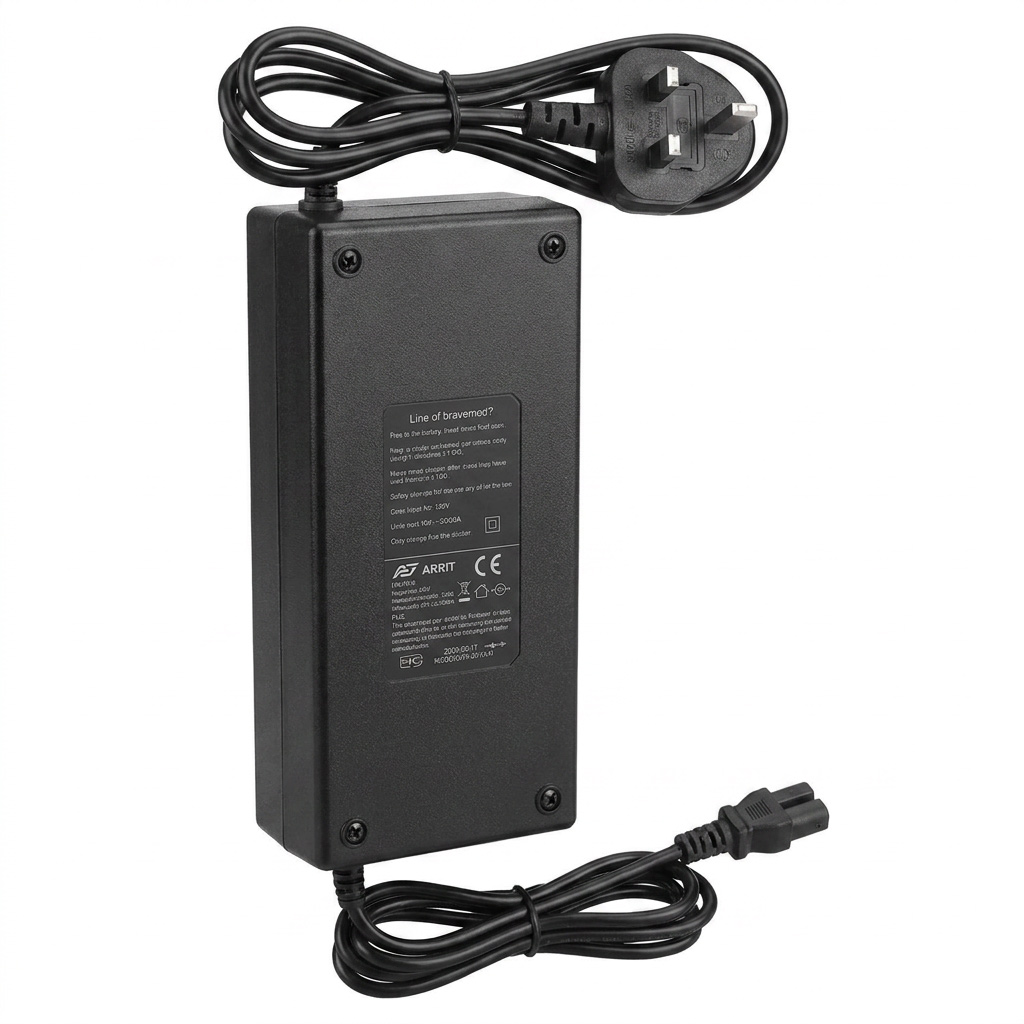
Charger Compatibility
Charger-to-battery matching is set by manufacturer specification (nominal voltage, full-charge voltage, chemistry, BMS charge profile). For international standards covering AC conductive charging interoperability — IEC 61851-1:2017 — the standard is referenced for its defined scope only; charger / battery matching outside that scope is set by the manufacturer datasheet.
IP Rating and Climate Scenario
IP rating describes resistance to dust and water ingress under defined test conditions, but it does not by itself determine a vehicle’s suitability for every climate. Tropical, monsoon, coastal, and high-humidity applications also require attention to connector sealing, drainage, corrosion resistance, cable routing, material selection, and maintenance practices.
The cost impacts shown are Indicative Zuboo engineering estimates; actual cost impact varies by design and volume.
| Sub-assembly IP rating | What it protects against | Recommended climate scenario | Typical use cases | Cost impact |
|---|---|---|---|---|
| IP54 | Dust-protected (limited ingress) + splashing water from any direction | Temperate urban, dry inland, low-exposure use | Urban commuter e-scooters in mild climates; indoor-stored fleets | Baseline |
| IP65 | Dust-tight + protected against low-pressure water jets | Tropical humid, monsoon-prone, coastal with light salt spray | Most tropical markets; mid-range e-mopeds; coastal cities | +10–20% vs IP54 |
| IP67 | Dust-tight + protected against temporary immersion (1 m / 30 min) | Heavy monsoon, frequent water crossings, dusty unpaved roads | Off-road, Boda markets, flood-prone areas | +25–40% vs IP54 |
| IP67 + conformal coating | As IP67 + corrosion-resistant PCB coating | Coastal salt spray, industrial pollution, high humidity + temperature | Marine / salt-spray environments; on-request Zuboo SKU | +35–50% vs IP54 |
Conformal coating addresses corrosion, not ingress, and is not a substitute for an IP rating.
Inventory Planning: ABC/XYZ, ROP, 90-Day Consumption
Inventory planning for an Electric Scooter Spare Parts Inventory should follow the same disciplined logic that any aftermarket business uses, but the lead-time and failure-mode characteristics of e-scooter components have their own quirks. ABC/XYZ classification and Re-Order Point (ROP) logic are planning frameworks rather than published industry standards.
ABC classification. Group each SKU by annual consumption value — A = highest (typically ~80% of value across ~20% of SKUs), B = medium, C = lowest. Annual consumption value is generally calculated as unit cost multiplied by annual usage.
XYZ classification. Group each SKU by demand variability — X = stable monthly consumption (CV < 0.5), Y = moderate fluctuation (CV 0.5–1.0), Z = erratic or project-driven (CV > 1.0).
Re-Order Point (ROP). A practical formula:
ROP = (average daily demand × supplier lead time) + safety stock
The safety-stock term depends on the dealer’s target service level, demand variability, and lead-time variability. Do not prescribe exact unit counts in this guide, because the right number depends on consumption history, supplier reliability, and the dealer’s service-level target. Run your own 90 days of consumption through the framework before committing to a number.
Where ABC/XYZ and ROP meet. Items in the A/X quadrant deserve tight ROP management and frequent review. Items in the C/Z quadrant can be ordered on a longer cadence or even on-demand from the manufacturer. Low-Consumption but Critical Components (structural brackets, specific mounting hardware, vehicle-critical electrical assemblies) require special planning because failure can immobilise a vehicle or significantly affect safety and service continuity.
90-Day Consumption Template. The companion Excel template provides three sheets: Daily Log (day-by-day SKU transactions with auto-calculated closing stock), ABC_XYZ (post-90-day classification by consumption value × demand variability with auto-calculated CV), and ROP_Calc (Re-Order Point computation with auto-calculated reorder dates and actions).
Staged Replenishment Plan
The staged replenishment plan is designed to mitigate dead-stock risk on the first cycle, then shift to consumption-driven replenishment from cycle 2 onward. The five phases are:
| Phase | Timing | Action | Coverage |
|---|---|---|---|
| Phase 1 — Initial stocking (anchor) | At delivery (T₀) | Stock all Tier A + Low-Consumption but Critical Components at full recommended quantity. Stock Tier B at 50–60% of recommendation. | ≈ 6 months |
| Phase 2 — First replenishment | T₀ + 3 months | Compare 90-day consumption against Phase 1 quantities. Top up Tier A. Adjust Tier B up/down based on actual draw. | First ROP signal |
| Phase 3 — Quarterly cadence | Every 3 months thereafter | Run ABC/XYZ reclassification. Reorder only items below ROP. Move C-tier slow movers to on-demand ordering if > 60 days no movement. | Rolling |
| Phase 4 — Annual review | Every 12 months | Re-validate multipliers against actual consumption. Reduce Tier B plastic body panels (dead-stock risk). Recompute per-market ratios. Expect ±20% drift per market. | Annual |
| Phase 5 — Hub redistribution | Quarterly, between markets | If a Tier C plastic part is stuck in one market but moving in another, redistribute via existing shipping lane rather than reordering. | Between cycles |
Three Special modes apply to specific markets:
- Tanzania conservatism — Hold higher Tier A and Tier B in the first two cycles. Tighten after 6 months of measured consumption. Repair-response time in TZ is 30+ days, so safety stock is critical.
- Pakistan grid instability — Hold ≥ 30 chargers and ≥ 30 voltage stabilizers across cycles. Charger failure rate correlates with grid events.
- Brazil UV aging — Plastic body panels and labels: monitor storage age and rotate stock according to actual warehouse conditions. In high-UV environments, extended storage may accelerate brittleness and colour fading.
Regional and Platform-Based Stocking References
Data-source note. The regional stocking references in this article are based on practical after-sales experience and spare-parts allocation data from Zuboo-supported markets. They are adjusted according to product platform, historical service demand, road and terrain conditions, usage intensity, climate, customer operating scenarios, expected replenishment lead times, and local service capability. These figures are intended as planning references rather than universal industry failure rates.
Cross-platform note. Regional spare-parts data should not be interpreted as a direct country-to-country failure-rate comparison. The reference cases involve different vehicle platforms, configurations, operating conditions, and customer usage patterns. Differences may therefore reflect both market environments and product-specific characteristics.
The commercial allocation percentage and the regional stocking-value ratio are different planning measures. The approximately 1% allocation refers to the agreed spare-parts quantity provided under the customer-managed after-sales arrangement, while the regional percentages estimate the recommended spare-parts value relative to the vehicle wholesale value.
The Zuboo regional spare-parts annex BR / PK / TZ v1 provides market-specific starting recommendations, all normalized to 5 cabinets / 400 vehicles per shipment. The numbers below are starting recommendations derived from engineering inference and field experience; they must be re-validated against the dealer’s own 90-day consumption data.
| Market | Platform profile | Operating conditions | Target spare-parts value ratio |
|---|---|---|---|
| Sri Lanka (baseline) | 72V T3 e-scooter/e-moped, ~1500 W rated motor power, mid-size | Tropical monsoon, urban + suburban roads, moderate use intensity | ≈ 1.0% of vehicle wholesale value |
| Brazil (N70) | 48V / 60V compact urban, 500–800 W rated motor power, ≤ 32 km/h | Tropical/subtropical, UV extreme, long downhills, high-frequency low-intensity city commute, heavy delivery use | ≈ 1.3% of vehicle wholesale value |
| Pakistan (Hero) | 60V / 72V heavy-duty e-moped, 1000–1500 W rated motor power, family + cargo | Subtropical arid/semi-arid, hot summers (45°C+), poor road quality, grid instability, frequent overloading | ≈ 1.5% of vehicle wholesale value |
| Tanzania (XingRen Boda) | 72V Boda e-motorcycle, 2000–4000 W rated motor power, cargo + passenger | Tropical savanna, equatorial heat, red dust, dirt roads, flooding in wet season, 30+ day repair wait | ≈ 1.8% of vehicle wholesale value |
The table below compares each spare-parts category across markets. Use it to size the per-market order from your own Sri Lanka baseline, or treat it as a starting recommendation for markets where you do not yet have your own consumption data.
| Category | Sri Lanka (units) | Brazil (units) | Brazil × SL | Pakistan (units) | Pakistan × SL | Tanzania (units) | Tanzania × SL |
|---|---|---|---|---|---|---|---|
| 01 Frame | 1108 | 702 | 0.63 | 1688 | 1.52 | 2210 | 1.99 |
| 02 Body panels | 2090 | 1935 | 0.93 | 2900 | 1.39 | 3895 | 1.86 |
| 03 Suspension | 130 | 165 | 1.27 | 195 | 1.50 | 260 | 2.00 |
| 04 Wheels | 160 | 208 | 1.30 | 245 | 1.53 | 488 | 3.05 |
| 05 Brakes | 120 | 375 | 3.12 | 275 | 2.29 | 600 | 5.00 |
| 06 Lighting | 380 | 330 | 0.87 | 510 | 1.34 | 440 | 1.16 |
| 07 Controls | 184 | 386 | 2.10 | 371 | 2.02 | 508 | 2.76 |
| 08 Locks | 50 | 155 | 3.10 | 160 | 3.20 | 235 | 4.70 |
| 09 Electrical | 85 | 294 | 3.46 | 350 | 4.12 | 514 | 6.05 |
| 10 Cargo (carrier / rack) | 0 | 100 | — | 270 | — | 500 | — |
| 11 Hardware (fasteners) | 670 | 855 | 1.28 | 1080 | 1.61 | 1340 | 2.00 |
Practical Reading of the Table
- Brakes and electrical components scale up sharply in Brazil, Pakistan, and Tanzania — 3.0–6.0× the Sri Lanka baseline. Brake-pad and electrical-component turnover is influenced strongly by road quality, dust, humidity, usage intensity, and vehicle application—not by voltage platform alone.
- Frame turnover is lowest in Brazil (0.63×) because the N70 is a compact urban e-scooter with low-stress frames. In Pakistan and Tanzania, frames are 1.5–2.0× the Sri Lanka baseline because of road conditions and overload use.
- Cargo (carrier / rack) parts exist only in markets where the platform supports cargo use — Brazil (delivery), Pakistan (family + cargo), Tanzania (Boda passenger + cargo). Sri Lanka baseline has zero cargo SKUs.
- Locks and controls scale up universally — 2.0–4.7× across all markets. Treat these as fast-movers in every market.
- Lighting scales modestly (0.87–1.34×) because the LED lighting on the Zuboo platforms is reliable; turnover is driven by accident damage rather than wear-out.
After-Sales Service & RMA Procedure
Zuboo operates a structured global after-sales service system built on four principles: product reliability, responsive support, local service capability, and long-term partnership.
One-Year Warranty (Manufacturing Quality)
Zuboo provides a standard one-year warranty for electric mobility products. During the warranty period, if a product experiences a manufacturing defect or quality-related failure under normal operating conditions, Zuboo conducts a technical evaluation and provides an appropriate solution. Available solutions include replacement of defective components, supply of replacement spare parts, technical troubleshooting and repair guidance, replacement of complete units in qualifying cases, or other mutually agreed corrective solutions. Warranty claims are subject to technical evaluation and confirmation by the Zuboo after-sales or engineering team.
Spare-Parts Allocation with Every Shipment (Customer-Managed After-Sales)
For customers with their own technical and after-sales capabilities, Zuboo may offer an alternative support arrangement in which approximately 1% of the order quantity is provided as an initial spare-parts allocation. This arrangement is subject to the customer’s acceptance of the corresponding after-sales responsibilities. Once the agreed spare-parts package has been provided, additional after-sales support is handled according to the agreed commercial terms rather than as an unlimited free replacement commitment.
This option is generally suitable for customers with their own technical service and after-sales capabilities. Regional multipliers apply — see the table above for Brazil (≈ 1.3%), Pakistan (≈ 1.5%), and Tanzania (≈ 1.8%) starting recommendations.
Six-Step RMA Procedure
- Submit an after-sales request — Customer contacts the Zuboo sales representative or after-sales service contact with company name, order number, product model, vehicle identification number, date of purchase or shipment, detailed description of the issue, photos or videos, and relevant operating conditions.
- Preliminary technical evaluation — Zuboo’s technical team reviews the information and conducts a preliminary assessment.
- Issue classification and RMA confirmation — The team classifies the issue (manufacturing defect, assembly / installation issue, transportation damage, improper operation, unauthorized modification, normal wear and tear, or external environmental factors) and, where warranty replacement, spare-parts support, or further technical intervention is required, provides an RMA confirmation or service instruction.
- Solution implementation — Technical guidance, spare-parts replacement, product replacement, or remote engineering support (email, video conferencing, WhatsApp, or other agreed channels).
- Resolution confirmation — Customer confirms resolution of the service case; the RMA case is formally closed and recorded.
- Continuous quality improvement — After-sales cases are reviewed to identify recurring issues and opportunities for improvement.
Warranty Exclusions
The standard warranty generally does not cover failures or damage resulting from improper use or operation, unauthorized modification, accidents, improper maintenance or storage, normal wear and tear, consumable components, use of non-approved replacement parts, overloading beyond rated capacity, unauthorized electrical or software modifications, customer-controlled transportation or handling, or environmental conditions beyond the product’s specified operating requirements. Warranty eligibility is determined based on technical evaluation and the specific circumstances of each case.
Common Misconceptions and Pitfall Alerts
Common Misconception: “Every BLDC is an integrated drive unit.”
What users commonly believe: A “BLDC motor” and an “integrated drive unit” are interchangeable product categories.
What’s actually true: Many e-scooters use a hub motor with a separate external controller in its own enclosure; in those designs, the BLDC motor is not an integrated drive unit. Treating them as interchangeable is a frequent source of return and rework.
Common Misconception: “Hall-sensor wire color is standardised across manufacturers.”
What’s actually true: Wire colours and pin assignments vary by manufacturer and even between model years within the same vendor. Cross-check by pin number, not by wire colour.
Common Misconception: “You can estimate SOC from pack voltage alone.”
What’s actually true: Nominal versus full-charge voltage differs by chemistry; cell drift, load conditions, and temperature affect readings. Pack voltage is one input to SOC estimation, not a substitute for a calibrated BMS-based reading.
⚠ Pitfall Alert: Battery-safety deferral
Do not perform prescriptive repairs, disassembly, or cell-level interventions on Li-ion or LiFePO4 battery packs based on this article. Defer all battery-safety procedures to the manufacturer’s official service manual or to qualified personnel trained on the specific chemistry and pack configuration. For any battery pack showing swelling, leakage, or BMS-triggered protection events, route the pack through the manufacturer’s RMA workflow rather than attempting field repair.
⚠ Pitfall Alert: Unsourced precision
Avoid quoting arbitrary MOQs, failure rates, or warranty windows as if they were industry data. These numbers vary by manufacturer, model, market, and supply chain. Treat every quantitative claim that lacks a tiered source as a recommendation to verify, not as a planning constant.
Decision Framework: What to Stock and When to Reorder
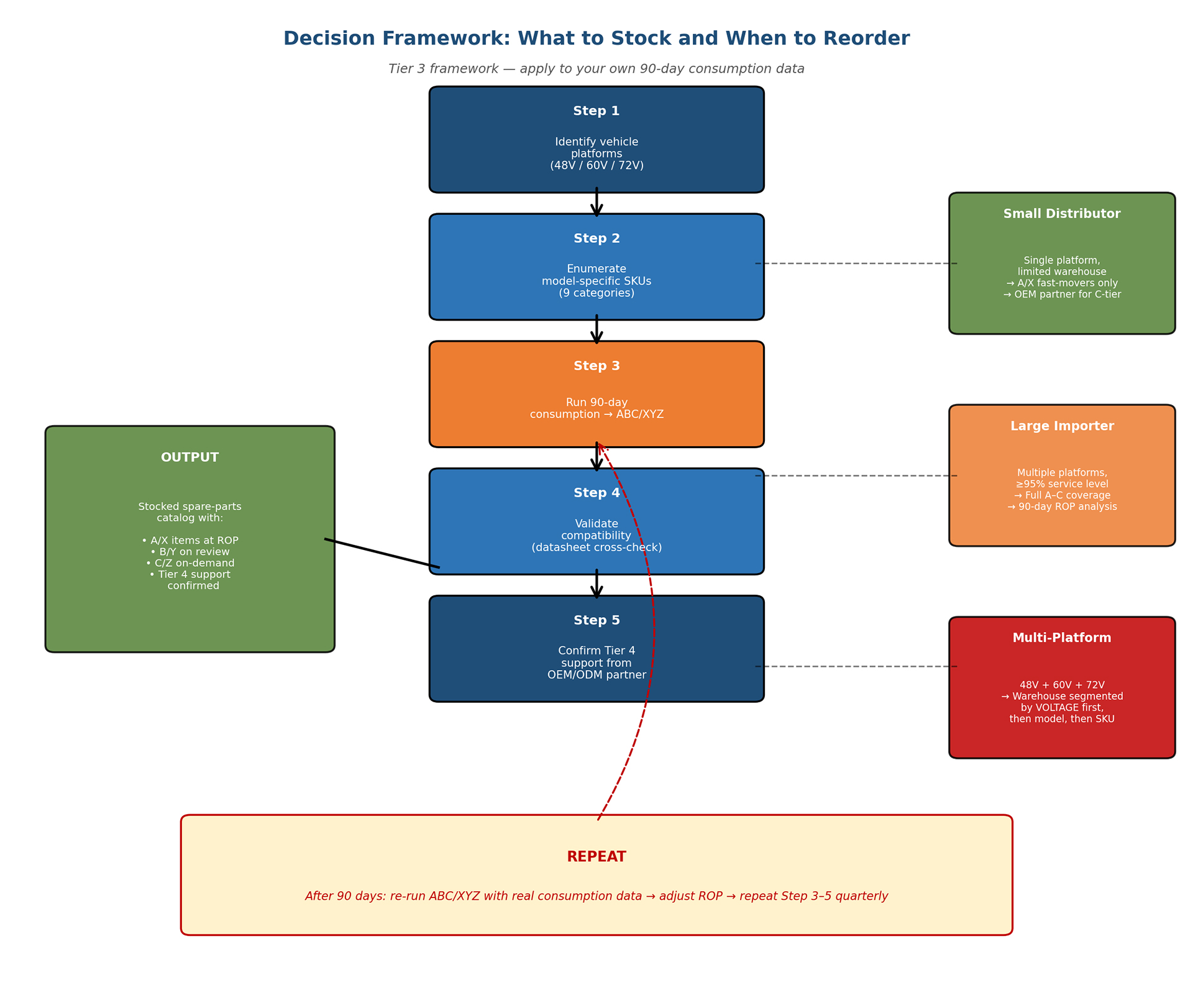
The flowchart above visualises the five-step process every dealer follows, with three conditional recommendation branches on the right and a REPEAT loop at the bottom indicating that inventory planning is iterative over 90-day cycles.
Step 1 — Identify vehicle platforms. Identify the platforms you actively support — for example, 48V e-scooters, 60V e-mopeds, 72V e-motorcycles.
Step 2 — Enumerate model-specific SKUs across the ten categories. For each platform, list the model-specific SKUs across the ten system categories (motor, external controller, integrated drive unit, battery pack, BMS, charger, display, throttle, brake components, wiring harness).
Step 3 — Run 90-day ABC/XYZ consumption. Classify each SKU by consumption value (A / B / C) and demand variability (X / Y / Z). Tier A/X items get tight ROP management; C/Z items get lower stock or on-demand ordering.
Step 4 — Validate compatibility. Cross-check against manufacturer datasheets: motor ↔ controller, battery ↔ charger, display ↔ controller, throttle ↔ controller, brake components ↔ motor / controller.
Step 5 — Confirm support from your OEM/ODM partner. Verify that the manufacturer can provide model-specific parts, OEM/ODM projects, SKD/CKD configurations, a documented RMA workflow, and lead-time commitments.
Conditional Recommendations (Three Branches)
| Branch | Profile | Stocking strategy |
|---|---|---|
| Small Distributor | Single platform, limited warehouse | Focus on A/X fast-movers only. Rely on your OEM/ODM partner for Low-Consumption but Critical Components. |
| Mid-sized Dealer | 200–1,000 units/year, multiple platforms | Full drive-unit core plus chargers and BMS boards for top SKU families. Hold a 2-unit service-loan pool per voltage class. |
| Large Distributor | >1,000 units/year or distributor function | Full taxonomy, 5-unit service-loan pool per voltage class, 6-week supply of A/B-class items, bench-test station for returned-pack failure analysis. |
After 90 days, re-run ABC/XYZ with real consumption data, adjust ROP, and repeat Steps 3–5 quarterly.
Conclusion
Running a Spare Parts Inventory for an overseas e-scooter dealership comes down to four practical moves. First, organise every spare part against a system-level SKU taxonomy — three motor-controller configurations, a voltage-platform ladder (48V / 60V / 72V), and a chemistry / connector / IP-Rating dimension for batteries and chargers. Second, run your own 90-day consumption through the companion Excel template so ABC/XYZ, ROP, and CV-based demand variability are calculated from your real service bay rather than from a published benchmark. Third, treat the Zuboo Regional Annex (Brazil ≈ 1.3%, Pakistan ≈ 1.5%, Tanzania ≈ 1.8% starting recommendations, all normalised to 5 cabinets / 400 vehicles) as a starting point, and re-validate every multiplier against your own 90-day data; Brazil N70, Pakistan Hero, and Tanzania XingRen Boda are reference platforms, not the only configurations that exist. Fourth, keep the standard one-year warranty and the customer-managed spare-parts allocation of approximately 1% of the order quantity as two separate commercial arrangements — neither one overrides the other.
For the practical implementation, use the Dealer SKU Master Data Framework to organise vehicle models, OEM part numbers, voltage platforms, connector families, and replacement relationships in one structured record; the Practical Spare Parts Inventory Example to translate the framework into an actual stocking list with separate fast-mover and low-frequency critical sections; and the 90-Day Consumption Analysis Template (Daily Log / ABC_XYZ / ROP_Calc) to run the inventory-planning workflow described above. Together, these downloadable resources turn the framework into a working tool you can adapt to your own market.
To discuss spare-parts planning, OEM/ODM projects, or SKD/CKD configurations for your specific market, please contact the Zuboo overseas dealer support team through the dealer portal or your assigned sales representative.
FAQ: Questions Overseas Dealers Actually Ask
Q1: What spare parts should an electric-scooter dealer keep in stock?
For the platforms you actively support, consider holding at least one model-specific motor, controller, or integrated drive unit where replacement lead time is long or local repair capability is limited. Smaller dealers should prioritize the highest-demand platforms and rely on the manufacturer for low-frequency replacements. Do not automatically stock one complete battery pack for every vehicle model. Battery inventory should be based on actual service demand, historical failure patterns, replacement lead time, battery configuration, local repair capability, and storage or transport requirements. In many markets, stocking battery subcomponents or approved replacement modules may be more practical than holding complete packs for every SKU.
Q2: How do battery voltage and chemistry affect charger selection?
A charger is matched to the pack’s nominal voltage, full-charge voltage, and chemistry. A 48V Li-ion pack (13S, full-charge 54.6 V) and a 48V LiFePO4 pack (16S, full-charge 58.4 V) need different charger output setpoints. Cross-chemistry charging is unsafe; verify the charger’s output voltage and chemistry label against the pack’s datasheet.
Q3: How should dealers match motors and controllers?
Match the voltage platform, the controller’s phase-current limit, the Hall-sensor arrangement (by pin number, not wire colour), and the connector family. Cross-check against the controller datasheet.
Q4: What should a dealer consider before ordering electric-scooter spare parts?
Verify the supported vehicle platform, the model-specific SKU, the voltage platform, the chemistry, the connector family, and the IP rating. Confirm that the supplier can provide a model-specific datasheet, an RMA workflow, and a documented lead time.
Q5: How can an electric-scooter manufacturer support overseas dealers with spare parts?
A manufacturer with a mature after-sales workflow can offer a dealer portal for service manuals, conformity declarations, model-specific spare-parts catalogs, and RMA handling. For OEM/ODM and SKD/CKD projects, the manufacturer can also support model-specific part numbers and lead-time commitments.
Q6: OEM versus aftermarket — what is the difference for inventory planning?
OEM parts are produced or specified by the original vehicle manufacturer and carry model-specific SKUs. Aftermarket parts are produced by third parties and may fit multiple models but vary in tolerance, firmware compatibility, and warranty support. For warranty-sensitive work, OEM parts are usually the safer choice; for cost-driven consumables, vetted aftermarket parts can supplement.
Q7: How do IP ratings affect which spare parts to keep on hand?
IP ratings describe resistance to dust and water under defined test conditions — only one part of environmental suitability. Match the IP rating to the sub-assembly’s role and your market’s climate, and consider connector sealing, drainage, corrosion resistance, and maintenance alongside the IP rating itself.
Q8: How should I size spare-parts inventory for a market like Brazil, Pakistan, or Tanzania?
Start with the Zuboo Regional Annex multipliers (starting recommendations, all normalized to 5 cabinets / 400 vehicles): Brazil ≈ 1.3%, Pakistan ≈ 1.5%, Tanzania ≈ 1.8% of vehicle wholesale value. Size per-category stock from the cross-market comparison table, then re-validate every multiplier against your own 90-day consumption data. These percentages should not be treated as automatic order quantities or warranty entitlements.
Q9: How do I run the 90-day consumption analysis?
Use the 90-day consumption template. Step 1: copy the Daily Log structure. Step 2: aggregate after 90 days and classify by ABC/XYZ with auto-calculated CV. Step 3: use ROP_Calc with your supplier lead time and target safety stock to get reorder dates. Re-run quarterly; re-validate multipliers annually.
Downloadable Dealer Resources
To support practical implementation, Zuboo provides downloadable resources that complement this article:
- Dealer SKU Master Data Framework — organise vehicle models, SKU numbers, part categories, OEM part numbers, voltage, connector or interface, compatible vehicle models, replacement relationship, minimum order quantity, lead time, and warranty / service notes in one structured record.
- Practical Spare Parts Inventory Example — translate the framework into an actual stocking list. Use it to identify high-priority parts, separate fast-moving and low-frequency critical items, plan initial inventory, estimate replenishment needs, and align parts selection with local service capabilities.
- 90-Day Consumption Analysis Template — Daily Log / ABC_XYZ / ROP_Calc sheets for running the inventory-planning workflow described in this article.
These downloadable materials are the practical reference for the framework described here. Do not treat the article’s regional table as a substitute for downloading and adapting these resources.
Compatibility Checklist
Supported Reference Platforms:
- Zuboo 48V e-scooter platforms (N70 compact urban, Defender, Pioneer, EX008, V15, Big Tank, Star Ship, H11, Dolphin, Paris)
- Zuboo 60V e-moped platforms (T3, T15, XingBo, MS300, KB, Leopard, Star Light, Liberty, XingYu)
- Zuboo 72V e-motorcycle platforms (T11, S3, XingRen Boda, Smilodon 2nd, XingYi, Tiger, AE4, Hero, YH, N80L, XM)
- OEM/ODM projects on the 48V / 60V / 72V base
- SKD/CKD configurations for overseas assembly
Battery Chemistry Options by Model (model-dependent):
- 48V / 60V / 72V Li-ion NMC packs (model-specific SKU)
- 48V / 60V / 72V LiFePO4 packs (model-specific SKU; cross-check BMS configuration)
- Lead-acid packs (not part of the Zuboo 48V / 60V / 72V product family)
Compatible Spare-Part Categories:
- BLDC hub motors (separate from external controller SKUs)
- External controllers (separate from integrated drive unit SKUs)
- Integrated drive units (motor + controller in a single IP67 housing)
- Battery packs with model-specific BMS
- Chargers matched to chemistry and full-charge voltage
- Displays matched to controller firmware
- Throttles matched to controller signal type (Hall 0.8–4.2 V)
- Brake components (mechanical or hall-effect, regen-compatible where applicable)
- Model-specific wiring harnesses
Environmental Compatibility:
- Operating temperature: model-dependent; refer to SKU datasheet
- Humidity: IP54 / IP65 / IP67 sub-assemblies available (model-dependent)
- Salt-spray exposure: conformal-coated IP67 variants available on request
- Submersion: not rated for sustained submersion on standard SKUs
See Also
- Internal: After-Sales Service & RMA Procedure — One-year warranty, customer-managed spare-parts allocation, six-step RMA workflow.
- Internal: Regional and Platform-Based Stocking References — Per-market multipliers and staged replenishment for Brazil, Pakistan, and Tanzania.
- Internal: Decision Framework — Five-step process with three conditional recommendation branches.
- Wikipedia: Brushless DC electric motor — BLDC construction and rotor-position sensing.
- Wikipedia: Battery management system — BMS function, cell balancing, and protection triggers.
- Wikipedia: IP Code — IEC 60529 ingress-protection rating codes.
- IEC 61851-1:2017 publication page — International standard for AC conductive charging, referenced only within its defined scope.
- Zuboo Technology — OEM/ODM manufacturer of 48V / 60V / 72V e-scooters, e-mopeds, and e-motorcycles.
Revision History
| Date | Version | Summary |
|---|---|---|
| 2026-09-017 | v1.0 | Initial publication. |
References
Evidence Tier ★★★★★ (International Standard): IEC 61851-1:2017 — “Electric vehicle conductive charging system — Part 1: General requirements”. Used strictly within its defined AC-charging scope. Link
Evidence Tier ★★★★ (Manufacturer First-Party): Zuboo Technology — OEM/ODM manufacturer of 48V / 60V / 72V e-scooters, e-mopeds, e-motorcycles for overseas dealers. Link
Evidence Tier ★★★★ (Manufacturer First-Party): Zuboo product range — full S / A / B / C grade matrix across Iconic / Hero / Main / Spearhead size categories, spanning 48V / 60V / 72V platforms. Link
Evidence Tier ★★★★ (Manufacturer First-Party): Zuboo BLDC hub motor specifications — seven current-production SKUs (1000 W to 2500 W) with controller bus / phase current limits, pole / slot count, and platform speed window. Local file
Evidence Tier ★★★★ (Manufacturer First-Party): Zuboo After-Sales Service & RMA Procedure — one-year warranty, customer-managed spare-parts allocation (~1% baseline with regional multipliers), six-step RMA workflow, customer after-sales responsibilities. Local file
Evidence Tier ★★★★ (Manufacturer First-Party): Zuboo Regional Spare-Parts Annex BR / PK / TZ v1 — Sri Lanka baseline plus Brazil N70, Pakistan Hero, Tanzania XingRen Boda; Cross-Market Comparison; Staged Replenishment Plan. Local file
Evidence Tier ★★★★ (Manufacturer First-Party): Three motor-controller configurations — (a) hub + external, (b) hub alone, (c) integrated drive unit. Local file
Evidence Tier ★★★★ (Manufacturer First-Party): Zuboo dealer-portal workflow — service manuals, model-specific spare-parts catalogs, RMA handling. Link
Evidence Tier ★★★ (Engineering Reference): Wikipedia, “Brushless DC electric motor” — BLDC construction and Hall-sensor operation. Link
Evidence Tier ★★★ (Engineering Reference): Hall-sensor pinout variability across three manufacturers — pin-number-not-colour principle. Local file
Evidence Tier ★★★ (Engineering Reference): Decision framework flowchart — five-step process with three conditional branches. Local file
Evidence Tier ★★★ (Engineering Reference): 90-day consumption analysis template (Excel) — Daily Log / ABC_XYZ / ROP_Calc sheets. Local file
Evidence Tier ★★★ (Engineering Reference): Zuboo Tier-3 Engineering Reference v1.0 — six reference deliverables. Local file
Evidence Tier ★★★ (Engineering Reference): Wikimedia Commons — BLDC motor assembly photo (img-001). Local file
Evidence Tier ★★★ (Engineering Reference): Wikimedia Commons — Smart Ni-MH battery charger photo (img-002). Local file
Evidence Tier ★★★ (Engineering Reference): Wikimedia Commons — 4S LiFePO4 BMS PCB with cell balancer photo (img-003). Local file