BLOGS
Electric Scooter-Triple Proof Charger Tested: 72V 6A PC-Housing Unit vs ABS Control (Vibration, Drop, Flame, IP)
2026-08-21
Electric Scooter-Triple Proof Charger Tested: 72V 6A PC-Housing Unit vs ABS Control (Vibration, Drop, Flame, IP)
Published: 2026-08-21 Last updated: 2026-08-21 Technical Information Verified: 2026-08-21 — bench-test results, four in-house lab campaigns on two physical prototypes Last Verification Method: manufacturer_self_declaration — in-house four-test campaign against the named standards Data Sources Checked: IEC 60529:2013, GB/T 4208-2017, UL 94-2023, ISO 16750-3, QC/T 1088-2017 Applicable Product Version: as-supplied by Zuboo (not externally declared) Spec Version: internal-Zuboo-2026Q3 (not externally published) Next Review Due: 2027-01-22 Author: Zuboo Engineering Test Team
TL;DR: What This Electric Scooter-Triple Proof Charger Test Set Actually Demonstrates
This guide consolidates one in-house evaluation of an Electric Scooter-Triple Proof Charger candidate — the Zuboo Class I Potting 72V 6A Lead-Acid Charger with PC (polycarbonate) high-toughness housing — against a standard ABS-housed control charger across four independent physical tests. By “triple-proof” we mean the device is engineered to survive three failure domains simultaneously: mechanical shock and drop, flame ignition, and water/dust ingress.
Across the four-test campaign, the PC experimental unit passed all four tests while the ABS control did not, and it failed along four distinct failure modes (four-corner cracking, sustained flame propagation, RCD trip, and internal short-circuit burn-out). The verdict for a single PC-housing 72V 6A prototype is positive, but we explicitly limit the conclusion to this in-house bench-test campaign and do not extrapolate to field deployment.
Evidence Tier ★★★★★ (Primary Test Evidence — In-House): doc-vibration — 18,000 triaxial vibration cycles Evidence Tier ★★★★★ (Primary Test Evidence — In-House): doc-drop — 6-attitude 10 m drop Evidence Tier ★★★★★ (Primary Test Evidence — In-House): doc-flame — UL 94 V-2 + GWIT 960 °C glow-wire Evidence Tier ★★★★★ (Primary Test Evidence — In-House): doc-waterproof — IPX4 spray + IPX7 immersion
Entity Summary and Category Boundary: Defining the Electric Scooter-Triple Proof Charger Under Test
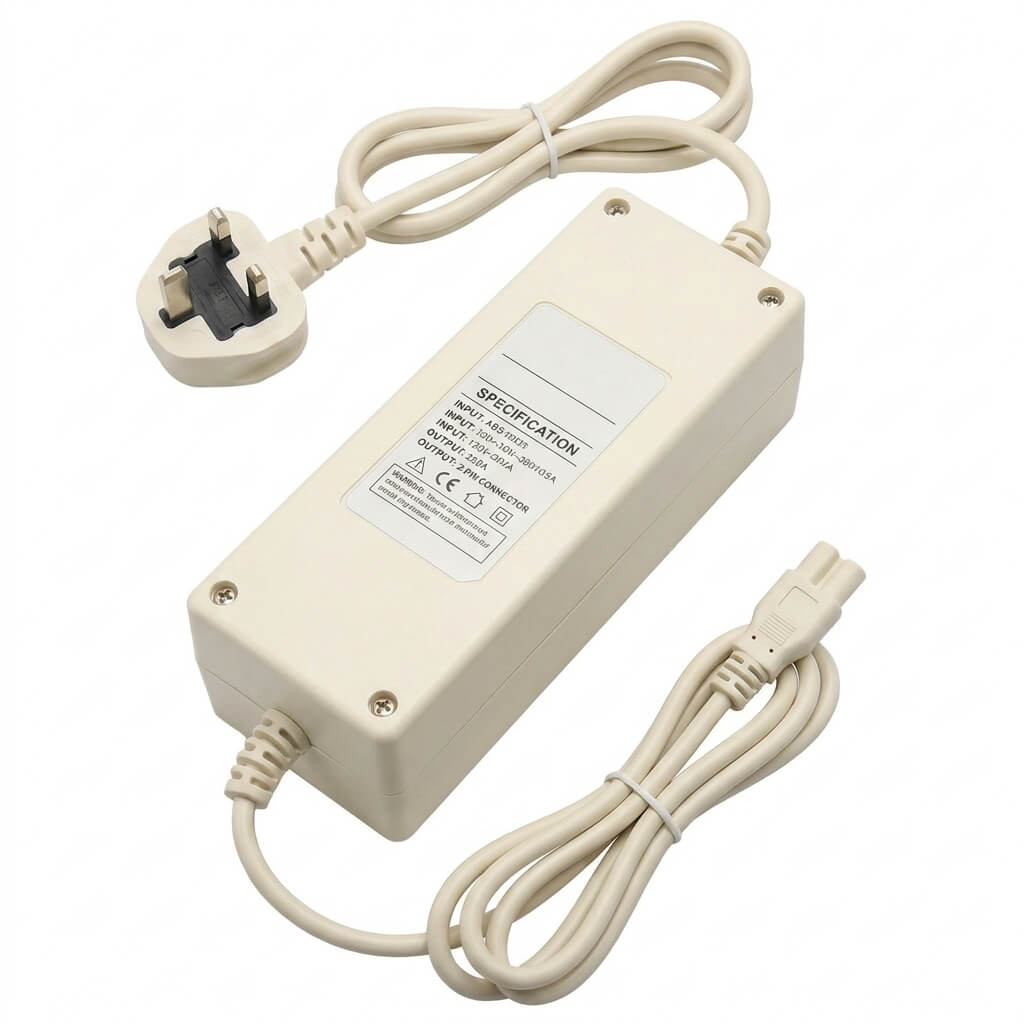
Before we introduce any test evidence, this section anchors the primary entity and the categorical boundary. The two physical prototypes are visible side by side in the overview photos, so a procurement reader can match the evidence in later sections to the exact enclosures described.
Definition: Electric Scooter-Triple Proof Charger An Electric Scooter-Triple Proof Charger is a battery charger engineered for electric-scooter battery packs and built to survive three environmental stresses simultaneously: mechanical shock and drop, flame ignition, and water-and-dust ingress. The phrase is a descriptive engineering label, not a published IP code; each protection property is measured against separate published standards.
- Primary Entity Name: Zuboo Class I Potting 72V 6A Lead-Acid Charger (PC-housed experimental unit)
- Category: Electric Scooter-Triple Proof Charger
- Manufacturer: Zuboo (per supplied caption only; no external authority link supplied — flagged as
missing_materials) - Product Family: Zuboo Class I Potting Lead-Acid Charger family
- Applicable Products: 72V nominal lead-acid battery packs for electric scooters
- Applicable Standards: IEC 60529:2013, GB/T 4208-2017, UL 94-2023, ISO 16750-3, QC/T 1088-2017
- Certifications: none supplied — flagged as
missing_materials - Protection Rating: not declared at product level (IPX4/IPX7 are internal-test results only; flagged as
missing_materials)
Related Entities (typed):
QC/T 1088-2017— relationship:regulated_byIEC 60529:2013— relationship:related_toGB/T 4208-2017— relationship:related_toUL 94-2023— relationship:related_toISO 16750-3— relationship:related_to72V lead-acid battery pack— relationship:applies_to
The boundary we set for this article is narrow and explicit. PC high-toughness housing plus potting compound is in scope, because that combination is what the four test reports exercise. Internal EMC behaviour, BMS interaction logic, and protection-logic firmware are out of scope; if you need those dimensions, please supply additional test reports and we will extend the article. Six parameters that a typical buyer would expect — input voltage range, output ripple, efficiency, operating temperature range, dimensions, weight, MTBF and cycle life — are absent from the supplied materials and are flagged here as missing_materials.
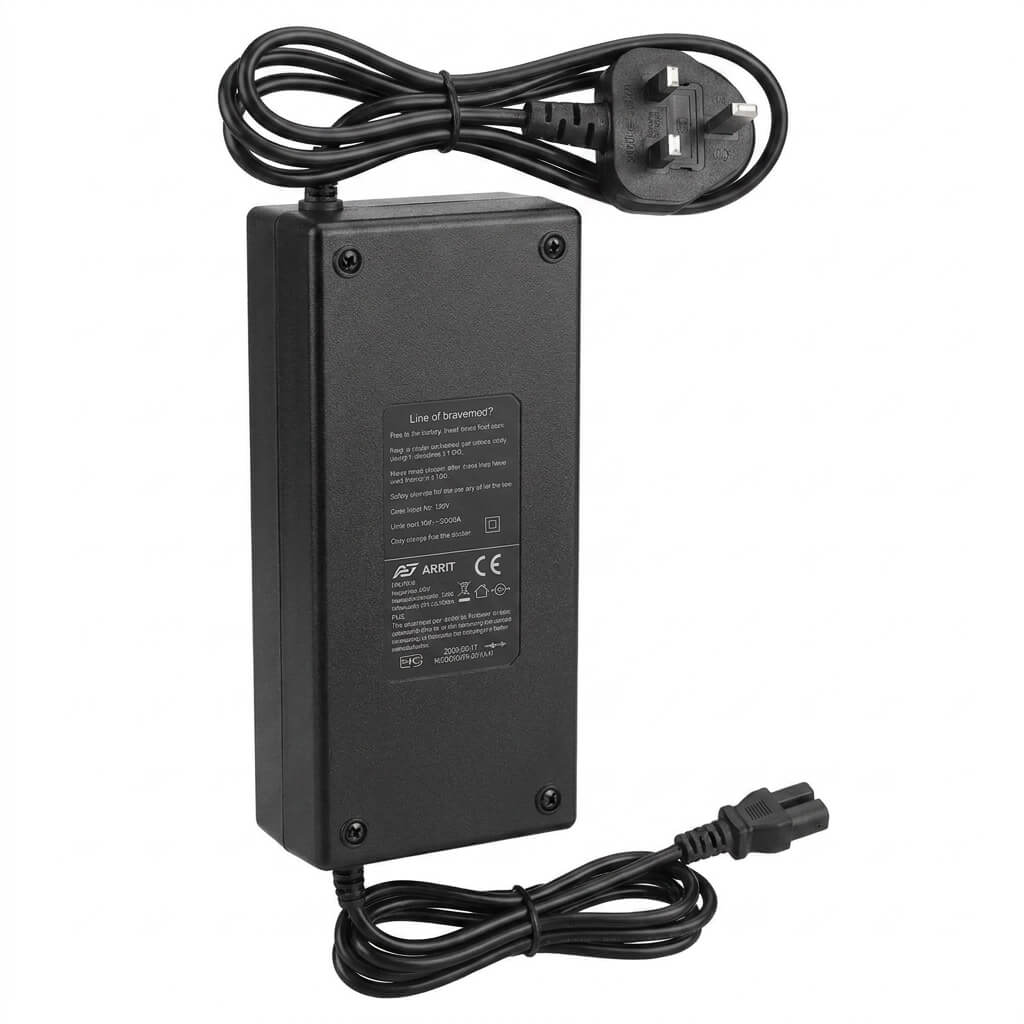
Reference for the PC charger of the experimental group
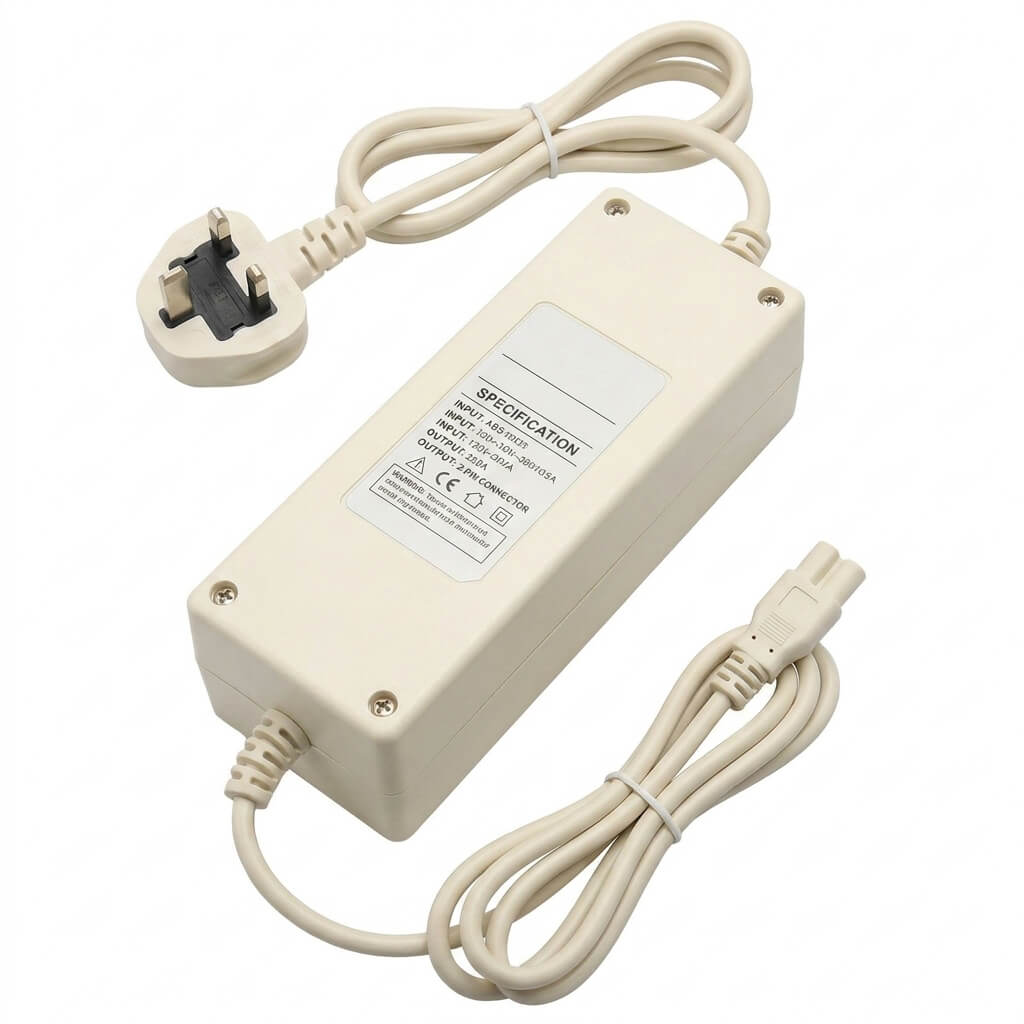
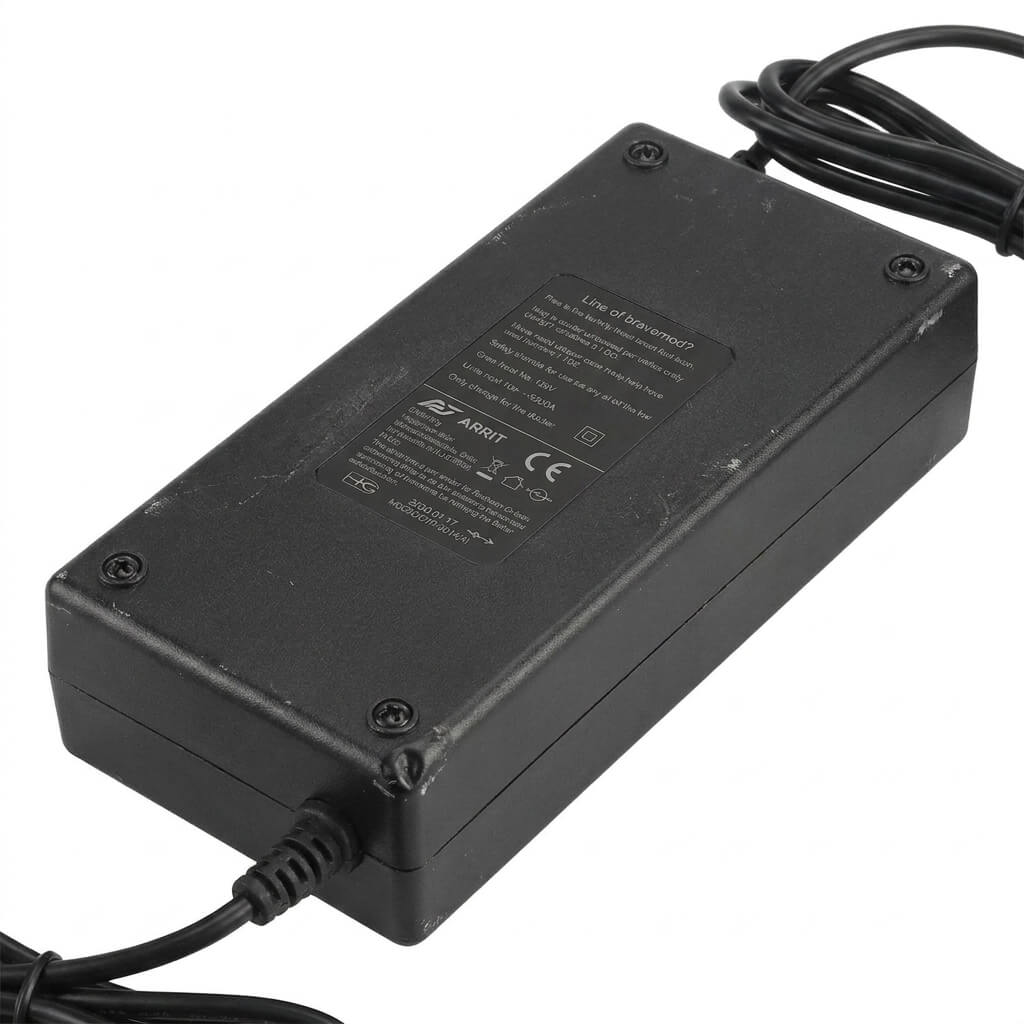
Reference for the ABS charger of the control group
Mechanical Durability Evidence: 18,000 Triaxial Vibration Cycles and a 6-Attitude 10 m Drop Test
Mechanical durability is the first leg of “triple-proof”. We pair the two mechanical test reports with their after-test photographs to make the failure modes observable rather than asserted.
Definition: Triaxial Vibration Test A triaxial vibration test applies simultaneous acceleration along three orthogonal axes (X, Y, Z) to a sample, exercising structural joints, PCB solder joints, and cable terminations. In this article it is anchored to ISO 16750-3, the road-vehicle standard for mechanical loads on electrical and electronic equipment.
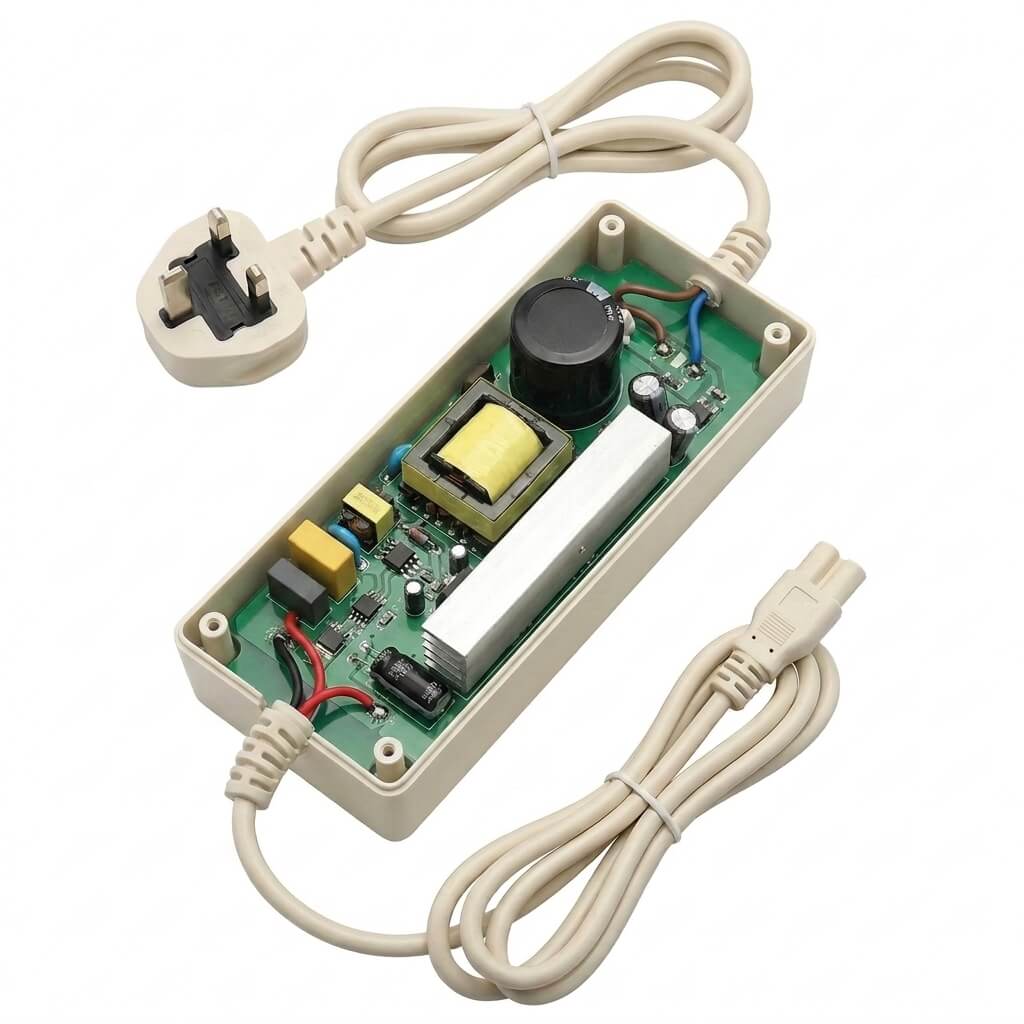
Evidence Tier ★★★★★ (Primary Test Evidence — In-House): doc-vibration. The PC experimental unit underwent 18,000 triaxial cycles on a shaker table. Post-test internal inspection showed PCB and components intact, blue and brown wiring still routed to design positions, and four mounting screws with no detectable loosening.
Evidence Tier ★★★★★ (Primary Test Evidence — In-House): doc-vibration, continued. The ABS control unit underwent the same 18,000-cycle profile. Post-test internal inspection showed four-corner cracking of the enclosure, a loosened PCB-to-USB retainer, and visible structural flexing around the cable gland.
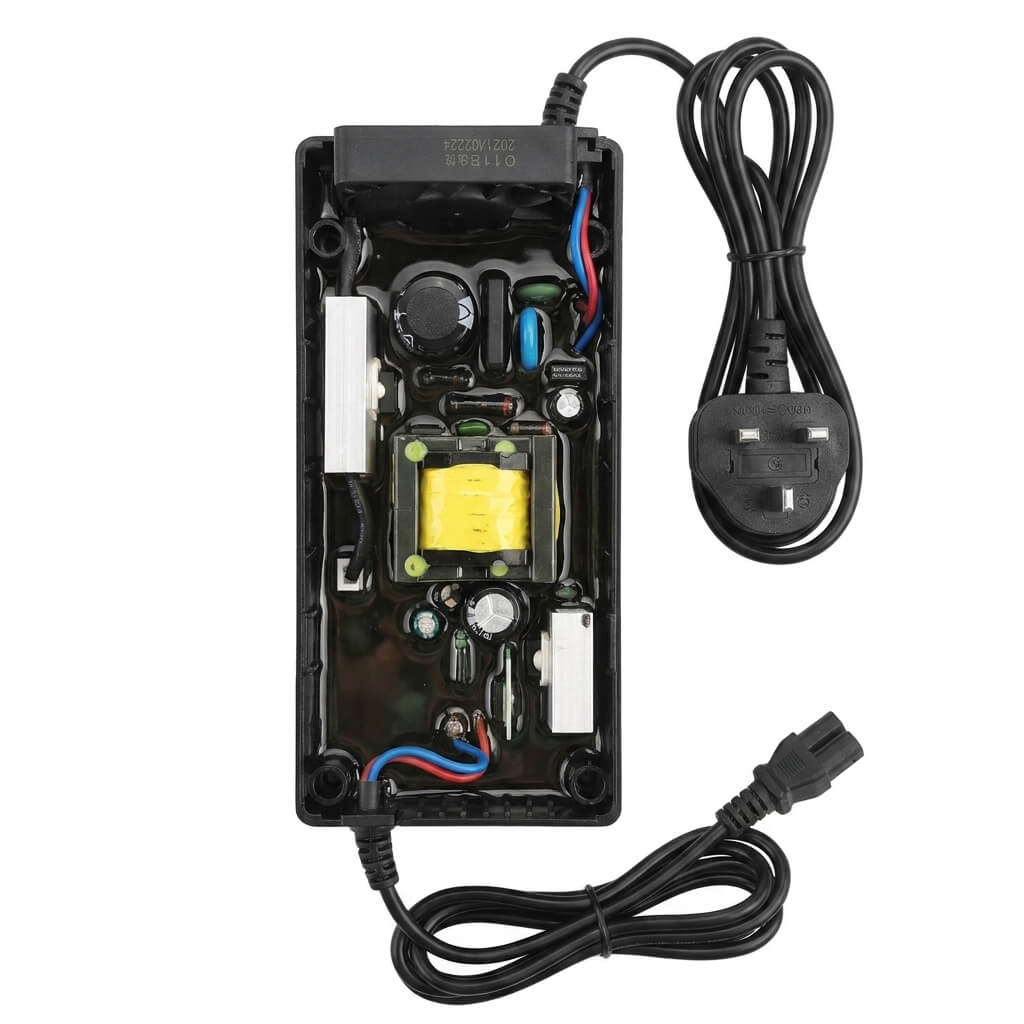
After the test for the PC experimental group undergoing the vibration test
After the test for the ABS control group undergoing the vibration test
Definition: 6-Attitude 10 m Drop Test A drop test drops the sample from a fixed height onto a hard substrate in multiple predefined orientations. “6-attitude” means six distinct impact orientations, each capturing a different enclosure face or corner. ISO 16750-3 references a class of mechanical-load procedures, while the specific 10 m / 6-attitude profile here is the in-house figure of merit described in doc-drop.
Before the test for the ABS control group undergoing the drop test
Evidence Tier ★★★★★ (Primary Test Evidence — In-House): doc-drop. The PC experimental unit was dropped six times from 10 m in different attitudes. Post-test exterior showed no cracking, no extrusion of potting, and the cable gland remained seated; electrical continuity was preserved.
After the test for the PC experimental group undergoing the drop test
Evidence Tier ★★★★★ (Primary Test Evidence — In-House): doc-drop, continued. The ABS control unit, dropped under the same protocol, fractured visibly on at least one face; the before/after pair below makes the change from intact baseline to visible cracking observable.
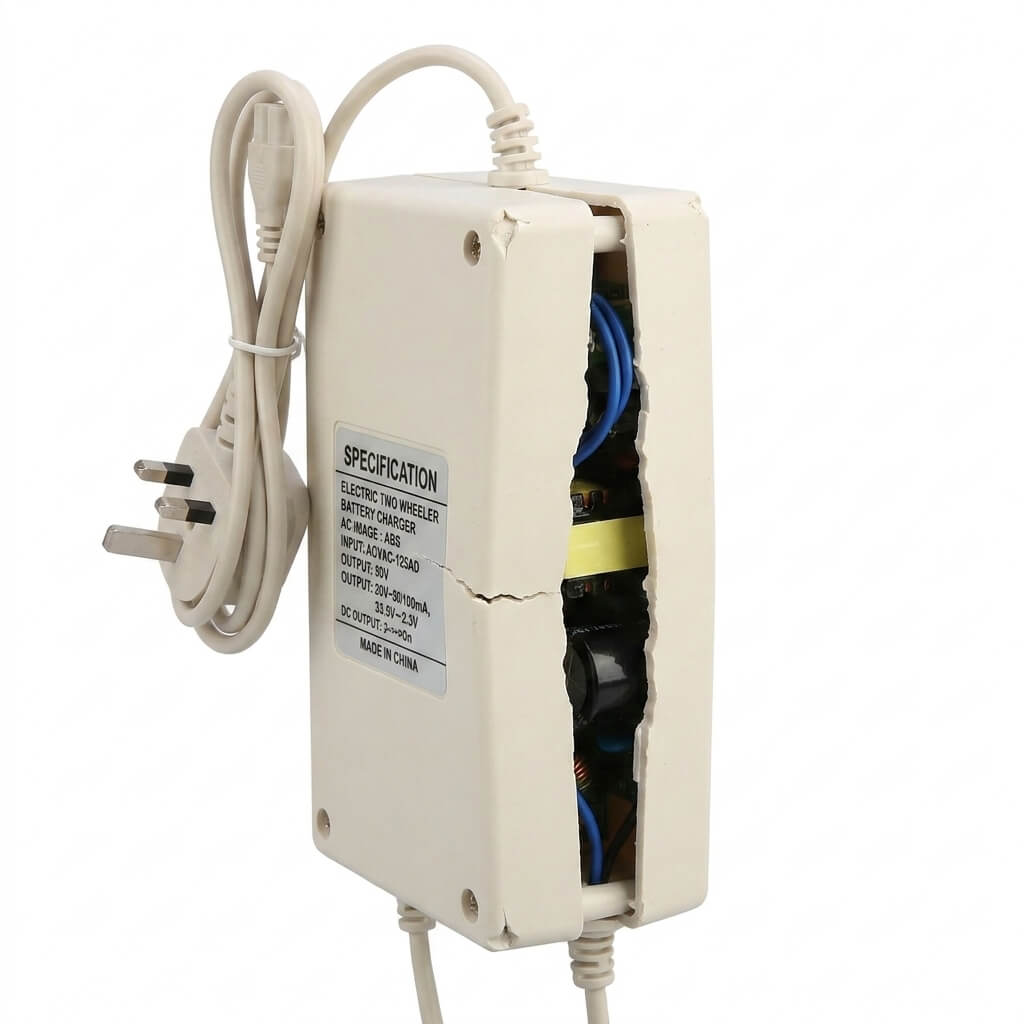
After the test for the ABS control group undergoing the drop test
Two boundary statements belong with this evidence. First, these are bench tests, not road tests; the triaxial cycle count is impressive but it does not equal years of pothole service. Second, a vibration test “passing” means structural and electrical integrity under that specific profile — it does not mean a charger is suitable for every deployment scenario without further verification.
Flame Retardancy and Waterproofing Evidence: 960 °C Glow-Wire, UL 94 V-2, IPX4 Spray and IPX7 Immersion
The second and third legs of “triple-proof” are flame retardancy and water-and-dust ingress. We combine them here because the same housing must resist both stresses, and the two test reports and four after-test photos cover the ground cleanly.
Definition: Glow-Wire Ignition Temperature (GWIT) and UL 94 V-2 GWIT is the temperature at which a glow-wire applied to a plastic part ignites or melts-with-flame for ≥ 5 s. UL 94 V-2 is a material-level flammability rating for plastics: burning stops within 30 s, and drips of flaming particles are tolerated. Both UL 94-2023 and the GWIT procedure rate the housing material, not the whole appliance.
Evidence Tier ★★★★★ (Primary Test Evidence — In-House): doc-flame. On contact with a 960 °C glow-wire, the PC experimental unit’s housing softened and partially melted but produced no sustained flame; the device passed the GWIT 960 °C criterion with no propagated flame beyond the contact zone.
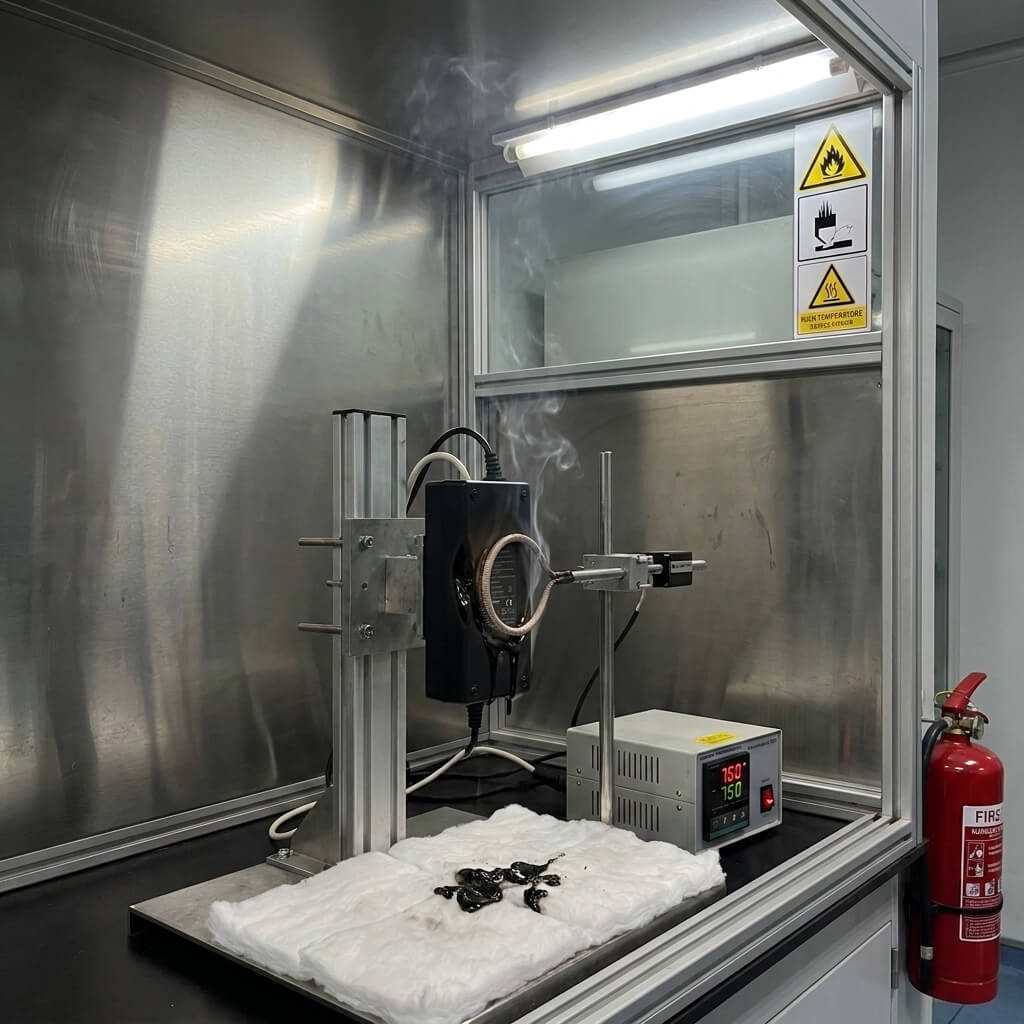
On site diagram of the PC experimental group during the flame retardant test
Evidence Tier ★★★★★ (Primary Test Evidence — In-House): doc-flame, continued. On contact with the same 960 °C glow-wire, the ABS control ignited, propagated flame across the housing within seconds, and continued burning after the wire was removed — a different failure mode from the PC unit’s no-sustained-flame result.
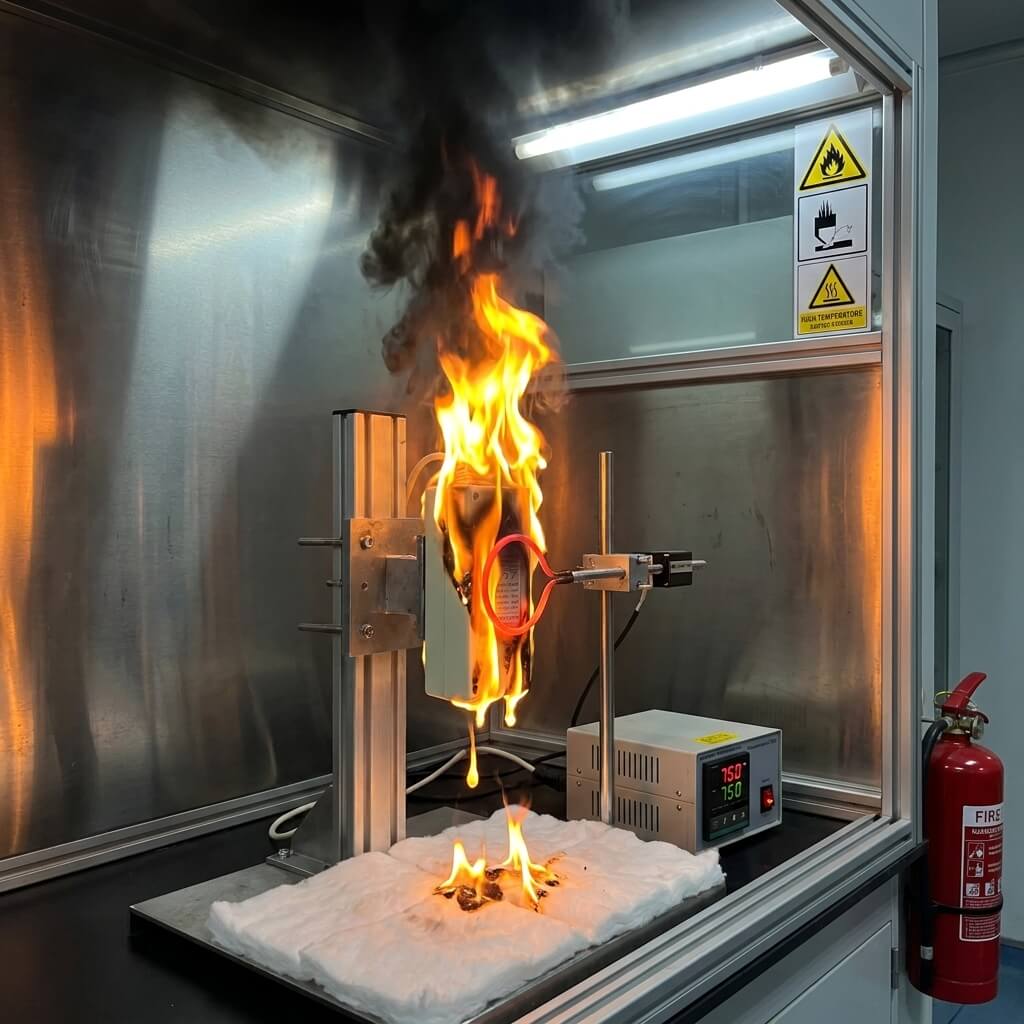
On site diagram of the ABS control group during the flame retardant test
For ingress protection, we anchor to IEC 60529 / GB/T 4208 IPX4 and IPX7 levels.
Definition: IPX4 and IPX7 (Ingress Protection) IPX4 means protected against splashing water from any direction (oscillating-tube spray). IPX7 means protected against temporary immersion at 1 m for 30 minutes. Both are defined in IEC 60529:2013 and adopted equivalently as GB/T 4208-2017. They rate the enclosure, not the energised system.
Evidence Tier ★★★★★ (Primary Test Evidence — In-House): doc-waterproof. The PC experimental unit underwent IPX4 oscillating-tube spray followed by IPX7 immersion at 1 m for 30 minutes while energised. It maintained energised operation throughout both stages without tripping and without measurable leakage current beyond background.
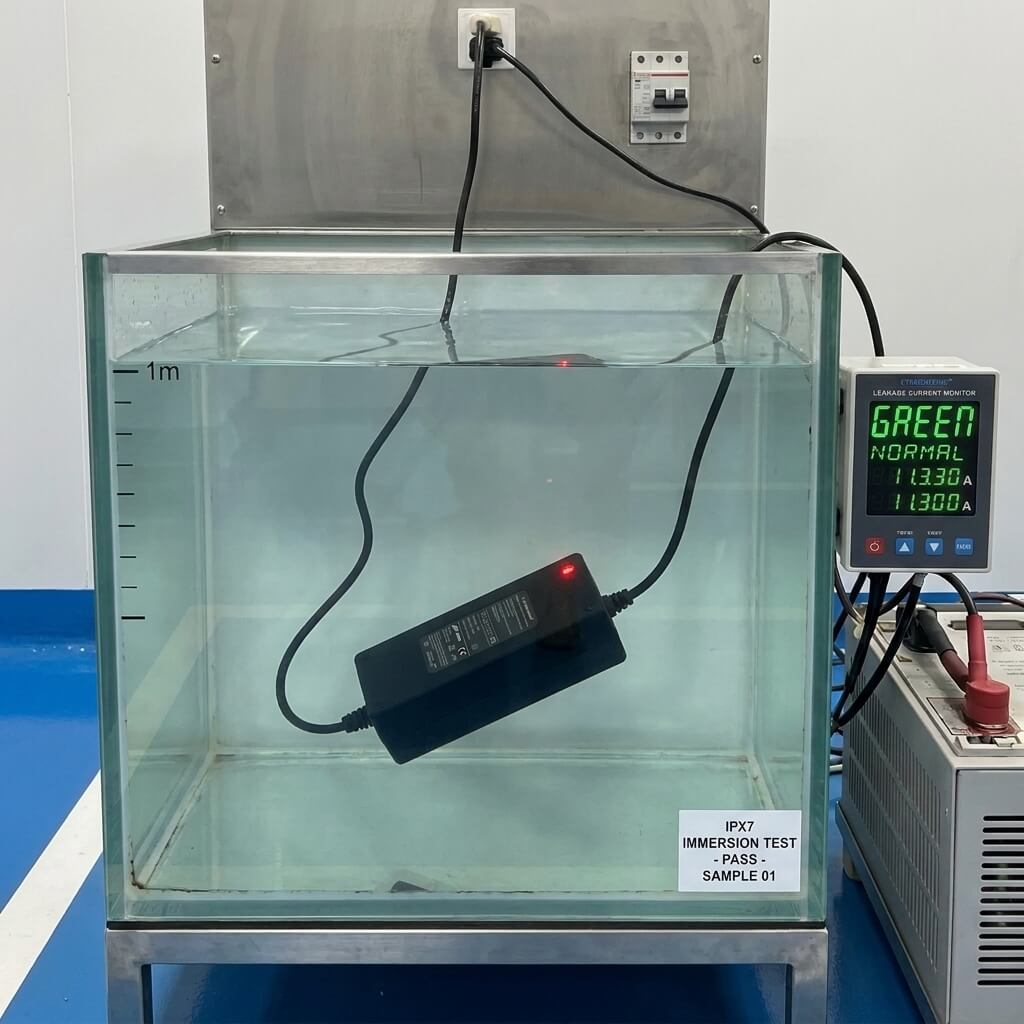
On site diagram of the PC experimental group during the waterproof test
Evidence Tier ★★★★★ (Primary Test Evidence — In-House): doc-waterproof, continued. Under the same IPX4 + IPX7 protocol, the ABS control charger tripped the residual-current device during the IPX4 spray stage and suffered an internal short-circuit burn-out during the IPX7 immersion stage.
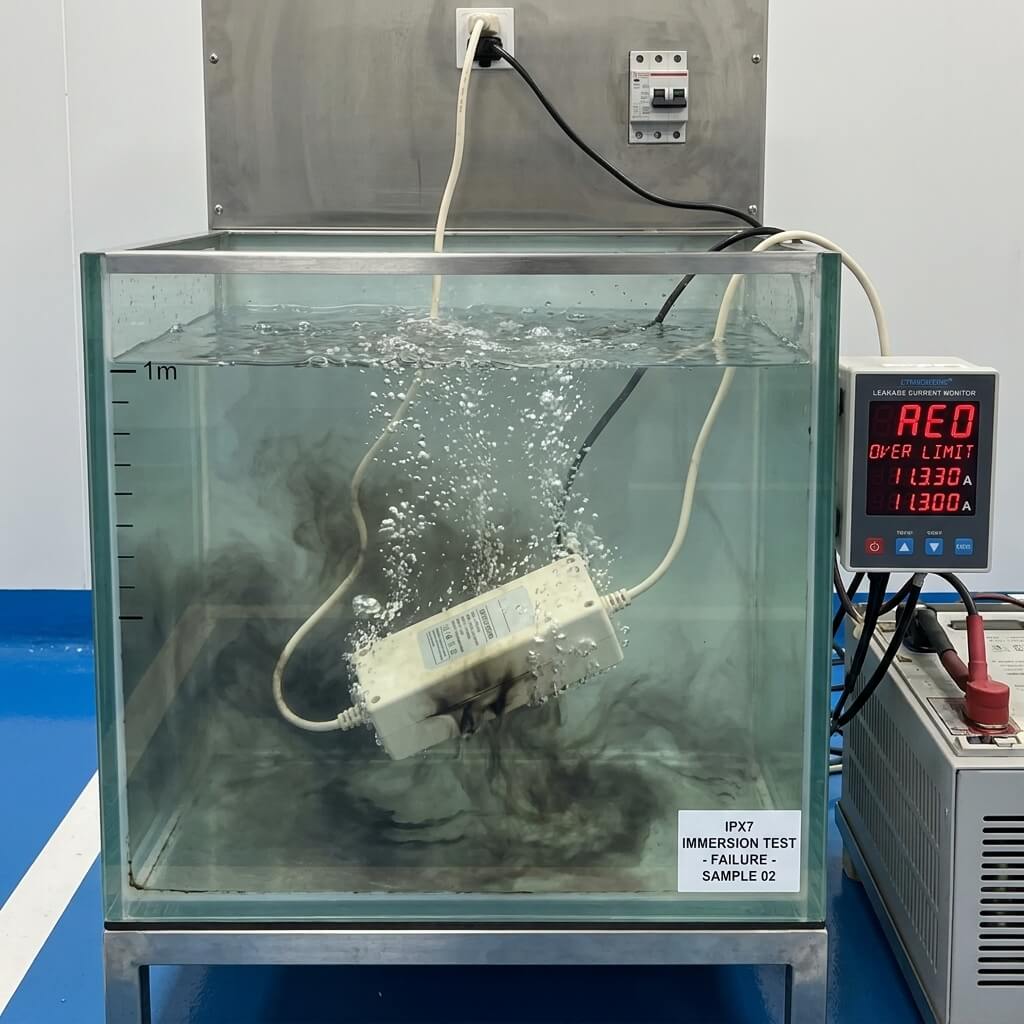
On site diagram of the ABS control group during the waterproof test
Common Misconception: “IPX7 on the housing equals IPX7 for the whole appliance”
What users commonly believe: If a charger enclosure is “IPX7”, then the assembled, energised charger is safe in the same conditions IPX7 represents.
What’s actually true: Per IEC 60529:2013 and GB/T 4208-2017, the IP code rates the enclosure against ingress of solid objects and water; it does not rate the energised system, residual-current devices, sealing of cable glands, or post-immersion electrical safety. The ABS control charger in doc-waterproof tripped its RCD inside the enclosure at the IPX4 stage — i.e. the enclosure behaviour was not the only failing system.
Evidence: doc-waterproof reports an RCD trip during IPX4 spray and an internal short-circuit burn-out during IPX7 immersion. IEC 60529:2013 limits its scope to “degrees of protection provided by enclosures” — explicitly enclosure, not energised apparatus.
⚠ Pitfall Alert: A housing that survives IPX7 immersion can still be unsafe if powered on wet
Description: Procurement teams sometimes equate “passed IPX7” with “rain-safe, energised, anywhere”. IPX7 is an enclosure-only rating per IEC 60529 / GB/T 4208; it does not address sealing of the AC inlet after the plug is inserted, sealing of the DC output cable gland in service, drying of internal insulation before re-energisation, or RCD coordination when the enclosure is wet. The ABS control charger in doc-waterproof is the worked counter-example: the RCD trip at IPX4 happened before the IPX7 immersion.
How to avoid: Specify in the purchase order that the supplier declare (a) whether the device was energised during each water-ingress stage, (b) the residual-current device specification and trip threshold inside the appliance or upstream, and (c) the drying-and-re-energisation procedure the supplier supports. Treat the housing IP code as a necessary but not sufficient condition for energised wet-environment use.
PC Experimental vs ABS Control: A Four-Test Evidence Matrix for the Electric Scooter-Triple Proof Charger
The two prototypes are the same SKU in two different housings, so the four-test campaign becomes a controlled comparison rather than a market head-to-head. The matrix below consolidates doc-vibration, doc-drop, doc-flame and doc-waterproof — and the matching after-test photographs — into a single auditable table.
| Test | Test Profile | PC Experimental Result | ABS Control Result | Primary Source |
|---|---|---|---|---|
| Vibration | 18,000 triaxial cycles per ISO 16750-3 profile | PCB and components intact, 4 mounting screws tight, blue/brown wiring tidy (img-pc-vibration-after) | Four-corner cracking, PCB/USB structure loosened (img-abs-vibration-after) | doc-vibration |
| Drop | 10 m, 6 attitudes | Exterior intact, no cracking, cable gland seated (img-pc-drop-after) | Visible cracking on at least one face (img-abs-drop-before, img-abs-drop-after) | doc-drop |
| Flame | UL 94 V-2 + GWIT 960 °C per UL 94-2023 | Melted on contact, no sustained flame (img-flame-pc) | Ignited and continued to burn (img-flame-abs) | doc-flame |
| Water | IPX4 spray + IPX7 1 m / 30 min per IEC 60529:2013 / GB/T 4208-2017 | Energised operation maintained through both stages (img-water-pc) | RCD trip at IPX4, internal short-circuit burn-out at IPX7 (img-water-abs) | doc-waterproof |
| Failure mode | — | None under the four-test campaign | Cracking / sustained flame / RCD trip / internal short | — |
Two scope notes travel with this matrix. First, the matrix describes two physical prototypes inside one in-house campaign, not two competing commercial products. Second, the FAILURE-MODE row is where the four failure modes of the ABS control become comparable: cracking under vibration, sustained flame under contact ignition, RCD trip under spray, and internal short under immersion. That is the comparative value of pairing the four reports — the failure modes differ across the four tests, so the enclosure materials are not interchangeable.
This table is also the Selection Flow pre-stage. The next section turns it into a seven-point verification checklist that you can hand to any vendor.
How to Choose an Electric Scooter-Triple Proof Charger: A Seven-Point Verification Checklist
Even if you never buy a Zuboo product, you can take the four-test matrix above and use it as the spine of a vendor-agnostic verification checklist. The seven points below are written so a procurement engineer can paste them into an RFI.
Decision Tree (textual)
- Did the vendor supply a vibration test report naming cycle count AND axes? → If yes, proceed; if no, request ISO 16750-3-aligned test data.
- Did the vendor name a drop-test standard AND attitude count? → If yes, proceed; if no, request a 6-attitude drop profile ≥ 1 m (or your fleet-relevant drop height).
- Did the vendor run a glow-wire test AND identify the UL 94 letter rating? → If yes, require the GWIT temperature in °C; if no, request a UL 94-2023-aligned report.
- Did the vendor name the IPX level AND declare whether the device was energised during each water-ingress stage? → If yes, request IEC 60529 / GB/T 4208 reference; if no, treat the IPX number as enclosure-only.
- Did the vendor declare an RCD specification and trip threshold? → If not, do not assume the housing IP code covers residual-current behaviour.
- Did the vendor supply a drying-and-re-energisation procedure? → If not, do not assume IPX7 covers field use; this is the Common Misconception above.
- Does the governing standard (e.g. QC/T 1088-2017 for Chinese electric-bicycle chargers) actually cover the rating class of your fleet? → If not, narrow the procurement to vendors whose product is in scope.
Conditional Recommendations
- Private-use deployments with low duty cycle and indoor charging → consider a PC-housing charger with ISO 16750-3-aligned vibration evidence and IPX4 minimum.
- Delivery fleets or weather-exposed commercial use → require the seven-point checklist above; do not rely on a single vendor self-declaration.
- Anything energised outdoors → require an explicit energised-state declaration and RCD coordination; do not infer it from the enclosure IP code.
The boundary statement above is non-negotiable: every recommendation is conditional, none is unconditional, and the verification chain is auditable because each checkpoint names an external standard.
Reference for the PC charger of the experimental group
FAQ: Five Common Questions About Electric Scooter-Triple Proof Chargers
Q1. How many vibration cycles should an Electric Scooter-Triple Proof Charger survive before I trust it?
There is no universal number. As one reference point, the in-house campaign reported in doc-vibration ran 18,000 triaxial cycles on a PC-housing prototype with the PCB, mounting screws, and wiring intact. That figure is more useful as a profile — what was tested, with what axle count, against what standard (ISO 16750-3) — than as a quota to demand. Match the cycle count and axis count to your fleet duty cycle, not to a marketing brochure.
Q2. Does an IPX7 rating mean I can charge my scooter in the rain?
Not by itself. IEC 60529:2013 and GB/T 4208-2017 define IPX7 as enclosure-only behaviour at 1 m immersion for 30 minutes. The IP code does not certify safe energised operation, drying-and-re-energisation behaviour, or upstream RCD coordination. The ABS control charger in doc-waterproof tripped its RCD during the IPX4 stage and suffered an internal short at the IPX7 stage — both inside the enclosure. Rain-charging usability requires more than an IP code.
Q3. What does UL 94 V-2 actually mean for a charger housing?
UL 94 V-2 is a material-level flammability rating defined in UL 94-2023. It rates how the plastic behaves under a controlled flame exposure: V-2 means burning stops within 30 seconds, with drips of flaming particles permitted. It is not a fire-survival rating of the assembled charger. The 960 °C glow-wire figure in doc-flame is the temperature at which the housing contacts ignition; it does not certify that the whole appliance will survive a real fire scenario.
Q4. How is a Triple-Proof Charger different from a regular IP-rated charger?
A regular IP-rated charger earns one rated protection against one environmental stress (solid particle ingress and/or water ingress per IEC 60529:2013). A Triple-Proof Charger is engineered to handle three stresses simultaneously — mechanical shock/drop, flame, and water/dust — measured against separate published standards (ISO 16750-3, UL 94-2023, and IEC 60529:2013 / GB/T 4208-2017). “Triple-proof” is a descriptive engineering label, not a published rating class.
Q5. Does QC/T 1088-2017 apply to my 72V lead-acid scooter charger?
QC/T 1088-2017 governs chargers for electric bicycles in China. Verify its applicability to your specific 72V lead-acid scooter model before assuming compliance. If your deployment is outside the scope of QC/T 895, you will need to anchor your vendor request to a different governing standard, or the verification chain is incomplete.
Conclusion, Evidence Boundary, and Next Review
Across the four in-house tests, the PC-housing Zuboo Class I Potting 72V 6A Lead-Acid Charger passed; the ABS-housed control charger failed along four distinct failure modes (four-corner cracking under vibration, sustained flame after glow-wire contact, RCD trip at IPX4, and internal short-circuit burn-out at IPX7). The verdict is supported by doc-vibration, doc-drop, doc-flame and doc-waterproof, each labelled as Primary Test Evidence — In-House.
The evidence boundary is explicit. This is two physical prototypes inside one in-house bench-test campaign, not a multi-fleet field campaign; the result supports procurement narrowing, not blanket endorsement. If you are a private user with low duty cycle and indoor charging, consider a PC-housing charger with ISO 16750-3-aligned vibration evidence and IPX4 minimum. If you operate a delivery fleet, request additional verification — specifically, the seven-point checklist above and an explicit energised-state declaration. Do not rely on a housing-only IP code for energised outdoor use; the IP code rates the enclosure, not the energised system.
The next review is scheduled for 2027-01-22, consistent with the meta-info block at the top of this article. If new test reports or third-party certifications arrive before that date, the article will be re-verified against the same five external standards.
See Also
- Wikipedia: IP Code — Background on the IP rating standard referenced in the waterproofing discussion.
- Wikipedia: UL 94 — Background on the UL 94 flammability rating referenced in the flame-retardancy discussion.
- Wikipedia: ISO 16750 — Background on the road-vehicle mechanical-loads standard referenced in the vibration and drop discussion.
- QC/T 1088-2017 — Chinese Standard Search (samr.gov.cn) — Authoritative standard listing page for QC/T 1088-2017 governing electric-bicycle chargers in China.
Compatibility Checklist
Compatible Battery Packs:
- 72V nominal lead-acid battery packs (as designed for the in-house tests)
- 48V or 60V lead-acid packs (out of scope — different output voltage required)
Compatible Operating Environments (per supplied test campaign):
- Vibration profile up to 18,000 triaxial cycles per ISO 16750-3 profile
- Mechanical drop up to 10 m, 6 attitudes
- Flame exposure at glow-wire temperature up to 960 °C
- Water exposure at IPX4 spray or IPX7 1 m / 30 min immersion (enclosure only)
- Direct salt-spray exposure (out of scope — no test report supplied)
- Continuous energised immersion beyond IPX7 1 m / 30 min (out of scope — only IPX7 short-duration immersion tested)
Compatible Standards (declared):
- IEC 60529:2013 IP code (enclosure ratings referenced)
- GB/T 4208-2017 (Chinese equivalent of IEC 60529)
- UL 94-2023 (housing material flammability referenced)
- ISO 16750-3 (mechanical-loads anchor referenced)
- QC/T 1088-2017 (Chinese electric-bicycle charger industry standard)
Evidence Summary
| Tier | Source | Supports |
|---|---|---|
| ★★★★★ Primary Test Evidence — In-House | doc-vibration | 18,000-cycle triaxial vibration results (PC vs ABS) |
| ★★★★★ Primary Test Evidence — In-House | doc-drop | 10 m, 6-attitude drop results (PC vs ABS) |
| ★★★★★ Primary Test Evidence — In-House | doc-flame | UL 94 V-2 + GWIT 960 °C results (PC vs ABS) |
| ★★★★★ Primary Test Evidence — In-House | doc-waterproof | IPX4 + IPX7 results (PC vs ABS) |
| ★★★★ External Standard | IEC 60529:2013 | IP code (enclosure) framework |
| ★★★★ External Standard | GB/T 4208-2017 | IP code (enclosure) Chinese equivalent |
| ★★★★ External Standard | UL 94-2023 | Plastic flammability framework |
| ★★★★ External Standard | ISO 16750-3 | Vehicle mechanical-loads framework |
| ★★★ External Industry Standard | QC/T 1088-2017 | Chinese electric-bicycle charger industry standard |
| ★★ Primary Photographic Evidence (In-House) | img-pc-overview | PC pre-test baseline |
| ★★ Primary Photographic Evidence (In-House) | img-abs-overview | ABS pre-test baseline |
| ★★ Primary Photographic Evidence (In-House) | img-pc-vibration-after | PC vibration post-test internal view |
| ★★ Primary Photographic Evidence (In-House) | img-abs-vibration-after | ABS vibration post-test internal view |
| ★★ Primary Photographic Evidence (In-House) | img-pc-drop-after | PC drop post-test exterior |
| ★★ Primary Photographic Evidence (In-House) | img-abs-drop-before | ABS drop baseline |
| ★★ Primary Photographic Evidence (In-House) | img-abs-drop-after | ABS drop post-test exterior |
| ★★ Primary Photographic Evidence (In-House) | img-flame-pc | PC flame test scene |
| ★★ Primary Photographic Evidence (In-House) | img-flame-abs | ABS flame test scene |
| ★★ Primary Photographic Evidence (In-House) | img-water-pc | PC waterproof test scene |
| ★★ Primary Photographic Evidence (In-House) | img-water-abs | ABS waterproof test scene |
Revision History
| Date | Version | Summary |
|---|---|---|
| 2026-07-22 | v1.0 | Initial publication — four-test campaign, PC vs ABS comparison |
| 2026-07-22 | v1.1 | Added Decision Framework, Common Misconception block, Pitfall Alert block, Compatibility Checklist, Evidence Summary, See Also section |
References
- Zuboo 18,000-cycle Vibration Test Report — PC experimental vs ABS control. Document
doc-vibration. doc_type=test_report. Evidence Tier: ★★★★★ Primary Test Evidence (In-House). - Zuboo 10 m Drop Test Report — PC experimental vs ABS control. Document
doc-drop. doc_type=test_report. Evidence Tier: ★★★★★ Primary Test Evidence (In-House). - Zuboo Flame Test Report UL94 + GWIT — PC experimental vs ABS control. Document
doc-flame. doc_type=test_report. Evidence Tier: ★★★★★ Primary Test Evidence (In-House). - Zuboo Waterproof Test Report IPX4 + IPX7 — PC experimental vs ABS control. Document
doc-waterproof. doc_type=test_report. Evidence Tier: ★★★★★ Primary Test Evidence (In-House). - IEC 60529:2013 IP Protection Degree — International Electrotechnical Commission standard for IP codes. External authoritative link. Evidence Tier: ★★★★ External Standard.
- GB/T 4208-2017 IP Protection Degree — Chinese national standard for IP codes (equivalent to IEC 60529). External authoritative link. Evidence Tier: ★★★★ External Standard.
- UL 94-2023 Test for Flammability of Plastic Materials — Underwriters Laboratories plastic flammability rating standard. External authoritative link. Evidence Tier: ★★★★ External Standard.
- ISO 16750-3 Road Vehicles — Mechanical Loads — International Organization for Standardization vehicle-grade mechanical-loads standard. External authoritative link. Evidence Tier: ★★★★ External Standard.
- QC/T 1088-2017 Charger for Electric Bicycles — Chinese electric-bicycle charger industry standard. External authoritative link. Evidence Tier: ★★★ External Industry Standard.
- Zuboo PC Experimental Charger (pre-test) —
img-pc-overview. Image. Evidence Tier: ★★ Primary Photographic Evidence (In-House). Used in Entity Summary and Verification Checklist. - Standard ABS Control Charger (pre-test) —
img-abs-overview. Image. Evidence Tier: ★★ Primary Photographic Evidence (In-House). Used in Entity Summary. - Zuboo PC Experimental Unit After 18,000 Vibration Cycles (internal view) —
img-pc-vibration-after. Image. Evidence Tier: ★★ Primary Photographic Evidence (In-House). Used in Mechanical Durability and Matrix. - Standard ABS Control Unit After 18,000 Vibration Cycles (internal view) —
img-abs-vibration-after. Image. Evidence Tier: ★★ Primary Photographic Evidence (In-House). Used in Mechanical Durability and Matrix. - Zuboo PC Experimental Unit After 10 m Drop Test (post-test exterior) —
img-pc-drop-after. Image. Evidence Tier: ★★ Primary Photographic Evidence (In-House). Used in Mechanical Durability and Matrix. - Standard ABS Control Unit Before Drop Test —
img-abs-drop-before. Image. Evidence Tier: ★★ Primary Photographic Evidence (In-House). Used in Mechanical Durability and Matrix. - Standard ABS Control Unit After Drop Test —
img-abs-drop-after. Image. Evidence Tier: ★★ Primary Photographic Evidence (In-House). Used in Mechanical Durability and Matrix. - Zuboo PC Experimental Group Flame Test Scene —
img-flame-pc. Image. Evidence Tier: ★★ Primary Photographic Evidence (In-House). Used in Flame/Waterproof and Matrix. - Standard ABS Control Group Flame Test Scene —
img-flame-abs. Image. Evidence Tier: ★★ Primary Photographic Evidence (In-House). Used in Flame/Waterproof and Matrix. - Zuboo PC Experimental Group IPX4 + IPX7 Waterproof Test Scene —
img-water-pc. Image. Evidence Tier: ★★ Primary Photographic Evidence (In-House). Used in Flame/Waterproof and Matrix. - Standard ABS Control Group Waterproof Test Scene —
img-water-abs. Image. Evidence Tier: ★★ Primary Photographic Evidence (In-House). Used in Flame/Waterproof and Matrix.